


Strong ENTP jobs and careers usually let you argue with ideas, sell a vision, and move on to the next problem before boredom sets in. Law, marketing and sales leadership, management consulting, product and software work, sales engineering, market research, film and TV production, industrial design, and starting your own business all come up often, and for good reason.
Just don't treat a type chart as a verdict. The Myers-Briggs Company says preferences "do not indicate skill or ability" and warns against using the assessment to select people for jobs. (The Myers-Briggs Company) ENTPs can be patient accountants and careful nurses. Type describes where your energy tends to go, not what you're capable of.
This guide lays out eleven careers ENTPs often explore, with 2025 pay and 2025–35 growth from the U.S. Bureau of Labor Statistics. It also takes an honest look at entrepreneurship, lists routes that don't need a four-year degree, and covers the conditions that tend to make ENTPs restless.
What ENTPs Tend to Look For in Work
ENTP stands for Extraversion, Intuition, Thinking, and Perceiving. You probably think out loud, spot patterns and possibilities quickly, judge ideas on their logic, and prefer to keep options open. (Our explainers on extraversion vs. introversion and judging vs. perceiving cover those letters.)
At work, that combination often shows up as a few wants:
New problems, regularly. The fifth time you solve the same one, it stops being interesting.
Someone to spar with. ENTPs often sharpen ideas by arguing them out.
Room to change the approach. A process you can't touch feels like a cage.
Visible results. Pitches that land, deals that close, products that ship.
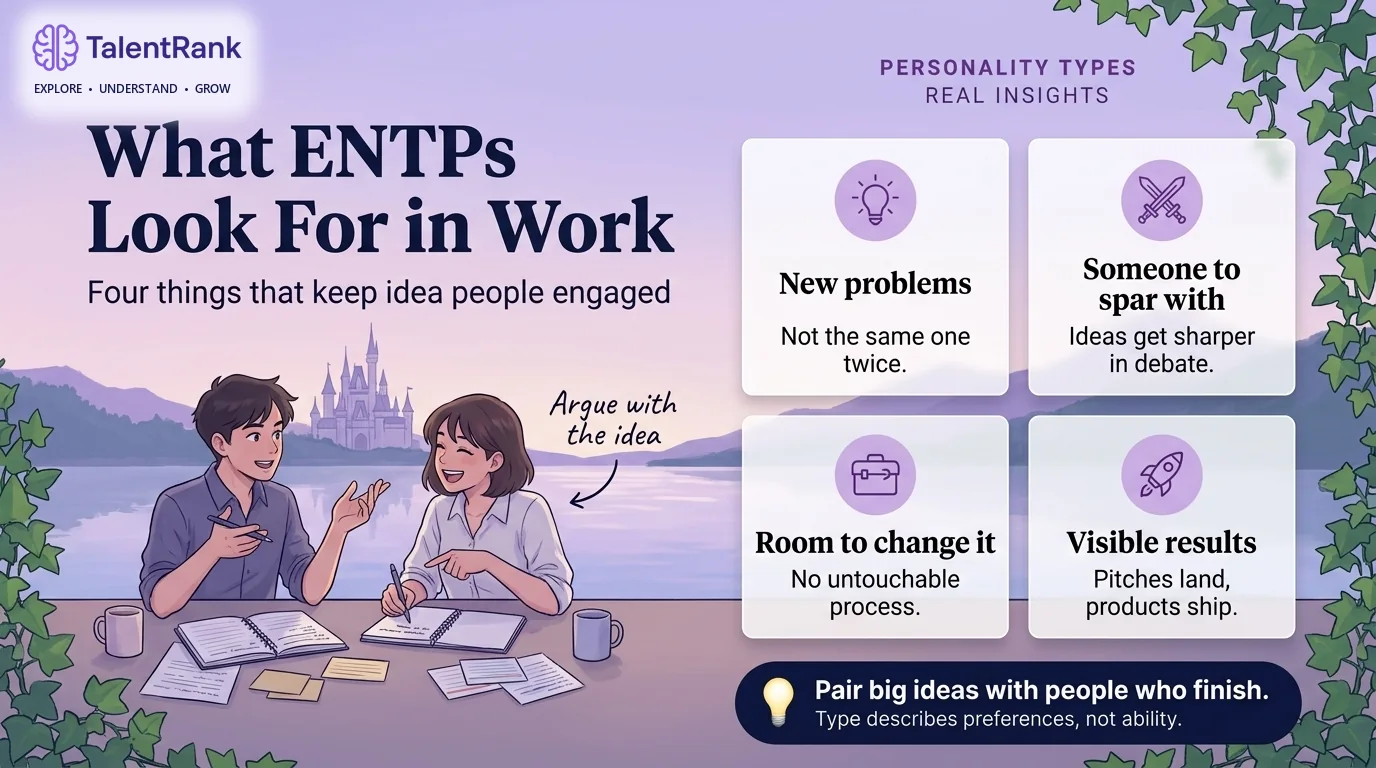
ENTP descriptions also tend to mention a flip side: finishing. If you're better at starting projects than at the last 20% of them, treat that as a design problem, not a character flaw. Many successful ENTPs deliberately work next to people who love closing loops, or pick roles where someone else owns the long tail of execution.
Best ENTP Jobs to Explore
These careers reward debate, persuasion, and fresh thinking. Figures come from the Bureau of Labor Statistics Occupational Outlook Handbook: median pay in May 2025 and projected employment change from 2025 to 2035.
Career | 2025 median pay | Projected growth, 2025–35 | Typical path in |
Advertising, promotions, and marketing manager | $165,780 | 6% | Bachelor's degree plus experience |
Lawyer | $159,670 | 5% | Law degree plus bar exam |
Sales manager | $148,270 | 4% | Bachelor's degree plus sales experience |
Software developer | $134,040 | 10% | Bachelor's degree |
Sales engineer | $124,900 | 3% | Bachelor's degree, often in engineering |
Top executive | $108,780 | 5% | Bachelor's degree plus 5+ years' experience |
Management analyst | $101,860 | 10% | Bachelor's degree plus experience |
Producer or director | $90,360 | 4% | Bachelor's degree plus production experience |
Industrial designer | $83,910 | 2% | Bachelor's degree plus portfolio |
Market research analyst | $78,760 | 7% | Bachelor's degree |
Public relations specialist | $74,750 | 2% | Bachelor's degree |
Source: BLS Occupational Outlook Handbook, pages updated August 2026. The top executive figure covers all top executives; BLS lists a $213,990 median for chief executives specifically.
Law and Advocacy
Lawyers get paid to find the weak point in an argument, which is roughly what many ENTPs do for fun. Litigation, where you argue in front of judges and juries, may suit you better than document-heavy work like contract review. Law school is long and expensive, so talk to practicing lawyers in a few specialties before applying.
Persuasion and Growth
Marketing managers and sales managers are two of the highest-paid roles on this list, and both reward reading people quickly and adjusting the pitch. Neither is usually a first job. Most sales managers start as sales representatives, and BLS lists related experience as a typical requirement for marketing managers.
Market research analysts sit closer to the data. They figure out what customers want and whether a product will sell. It's a good entry point for ENTPs who like strategy, and BLS projects 7% growth. Public relations specialists shape the story an organization tells, often under deadline.
Technology and Product
Software developers can work on greenfield projects that suit an ENTP's appetite for new problems. Sales engineers are a less obvious fit worth knowing about: they explain complex technical products to buyers, which combines technical depth with persuasion. The 2025 median was $124,900.
Product management doesn't have its own BLS category, but it's a common destination for ENTPs in tech. The role is part strategy, part negotiation, and part translating between engineers and customers.
Strategy and Leadership
Management analysts, often called consultants, move from client to client and problem to problem, which keeps things fresh. BLS projects 10% growth. Top executives set strategy for whole organizations. That usually takes years of experience, and the job includes plenty of the routine oversight ENTPs find dull.
Creative Industries
Producers and directors juggle creative vision with budgets, people, and constant problem-solving. Industrial designers invent and redesign physical products, from kitchen tools to medical devices, and need a strong portfolio to get hired.
Should an ENTP Start a Business?
Entrepreneur shows up on nearly every ENTP career list. Some ENTPs love it. Before you quit, look at the base rates. BLS data show that only about half of new businesses are still operating five years after they open. (BLS Business Employment Dynamics)
That doesn't mean don't do it. It means test cheaply first. Build a side project, sell something small, or join an early-stage company to see the work up close. You'll learn whether you enjoy the parts of running a business that aren't brainstorming: payroll, taxes, customer complaints, and the same sales call for the hundredth time.
Hypothetical example: an ENTP marketing specialist has an idea for a scheduling tool. Instead of quitting, she spends three months selling a manual version of the service to five local businesses on weekends. Three pay. Two cancel. She learns more about pricing and follow-up in those months than she would from a year of planning.
ENTP Jobs That Don't Require a Four-Year Degree
Several ENTP-friendly paths start without a bachelor's degree:
Insurance sales agents need a high school diploma and a state license. The 2025 median was $62,280, with 3% projected growth.
Real estate sales agents also need a license. The median was $52,830, and income is usually commission-based.
Sales development and account executive roles in tech often hire based on performance rather than degrees, and they can lead into sales management.
Sales rewards the ENTP knack for persuasion, but pay can swing a lot from month to month. Check how commission works before you sign.
ENTP-A and ENTP-T Jobs
The -A (Assertive) and -T (Turbulent) suffixes come from 16Personalities, not the official MBTI. 16Personalities adds a fifth scale it calls Identity and builds its model on Big Five research. (16Personalities)
There's no separate list of ENTP-A or ENTP-T jobs. What the label might hint at is how you handle pressure and rejection. If you identify as Turbulent, roles judged mostly on public metrics, like commission-only sales, may feel harder at first. That's something to test, not a reason to avoid them.
ENTP Jobs to Avoid (or Conditions to Watch)
Most "ENTP jobs to avoid" lists name roles like data entry clerk, bookkeeper, or assembly-line worker. The logic is that ENTPs hate routine. That's a tendency, not a rule, and plenty of ENTPs work in structured fields by choosing roles within them that involve change and problem-solving.
What tends to wear ENTPs down:
Work that repeats with nothing left to improve.
Rules that can't be questioned, even when they're clearly wrong.
Isolation from people and conversation for long stretches.
Heavy detail work with no variety, like reconciling records all day.
Slow organizations where every idea dies in committee.

How to Choose Between ENTP Career Options
ENTPs rarely run out of ideas. The hard part is committing long enough to find out whether one works.
Pick three careers from this guide.
Read the daily tasks for each on O*NET OnLine. Pay special attention to how much of the day is routine.
Talk to one person in each role and ask what the most repetitive part of their week is.
Run a small, time-boxed test: a freelance project, a side business, a short course.
Set a decision date, and stick to it.
If you want another lens, the Holland Code groups careers by interests. Many of the roles above fall under its Enterprising theme, which centers on persuading and leading.
Look Past the Four Letters
Two ENTPs can have very different work profiles. One is organized and steady. Another is brilliant at pitching and struggles with follow-through. Trait measures pick up those differences. Openness to experience, for example, tracks curiosity and appetite for new ideas. (Here's what high openness can mean for your career.)
The TalentRank assessment measures your Big Five personality traits and takes about 12 to 15 minutes. It won't confirm an MBTI type or choose a job for you. It can show where you land on traits like openness, extraversion, and conscientiousness, which help explain whether you'd enjoy running a business or advising one. Take the TalentRank assessment and use it as one data point among several.
Frequently Asked Questions About ENTP Jobs
What is the best job for an ENTP?
There isn't one. ENTPs often enjoy law, marketing, sales leadership, consulting, product work, and creative industries, where debate and new ideas are part of the job. Skills and the specific workplace matter as much as type.
What jobs should ENTPs avoid?
No job is off-limits because of type. It's more useful to avoid conditions that wear ENTPs down: repetitive work with nothing to improve, rules that can't be questioned, long isolation, and slow organizations where ideas stall.
Are ENTPs good entrepreneurs?
Some are. ENTPs often generate ideas and sell them well. Running a business also means months of routine work, and BLS data show about half of new businesses close within five years. Testing an idea on the side first is a smart move.
What ENTP jobs pay the most?
In this guide, marketing managers had the highest 2025 median pay at $165,780, followed by lawyers at $159,670 and sales managers at $148,270, according to BLS. Most of those roles require years of experience or professional training.
Can an ENTP work a structured job?
Yes. Many ENTPs do well in structured fields by choosing roles that involve change, like process improvement, consulting, or product work, rather than routine execution.
Is there a difference between ENTP-A and ENTP-T jobs?
No. The A/T suffix comes from 16Personalities, not the official MBTI, and the same careers apply to both.
Final Takeaway
ENTP careers work best when there's always a new argument to win or a new problem to crack. Law, marketing, sales leadership, consulting, product, and creative work all offer that. The risk isn't picking the wrong field. It's never testing any of them long enough to know. Choose three, run small experiments, and give yourself a deadline.