


Search for INFP celebrities and you will quickly find actors, musicians, writers, artists, and other public figures described as this personality type. Some names appear on list after list. That does not mean every label is confirmed. Celebrity personality typing often relies on third-party interpretation of interviews, biographies, public behavior, and creative work rather than a documented assessment result.
This guide takes a more careful approach. It separates a documented result from an attributed type, a debated interpretation, and a retrospective historical typing. You will find recognizable examples, including Stephen Colbert, Keanu Reeves, Kurt Cobain, Björk, Tim Burton, Fiona Apple, J.R.R. Tolkien, and Virginia Woolf, but the goal is not to declare strangers' inner lives with certainty. It is to show what the public evidence can and cannot support.
The table below summarizes famous people who are documented, commonly listed, or frequently discussed as INFP. “Attributed” means third-party personality sources apply the label without a direct result verified for this article.
Person | Known for | Evidence status | Main caveat |
Stephen Colbert | Comedian and TV host | Documented dated result | A 2015 practitioner-led TV segment reported INFP; it does not establish an unchanging lifelong type |
Keanu Reeves | Actor | Attributed / third-party | Commonly labeled INFP, but no direct assessment result was verified |
Johnny Depp | Actor and musician | Attributed / third-party | Public persona and acting choices are not assessment evidence |
Andrew Garfield | Actor | Debated | INFP analyses exist, while current sources also assign ISFP and other types |
Audrey Hepburn | Actor and humanitarian | Retrospective / debated | INFP and ISFP interpretations both circulate; she died before current online typing culture |
Tim Burton | Filmmaker and artist | Attributed / third-party | Frequently labeled INFP, but artistic style alone cannot establish type |
Kurt Cobain | Musician | Retrospective / debated | Frequently listed as INFP, with active ISFP and other counterarguments |
Björk | Musician and artist | Debated | Sources disagree among INFP, INFJ, ENFP, and other interpretations |
Fiona Apple | Singer-songwriter | Attributed / debated | INFP is common in typing communities, not a verified result |
Thom Yorke | Musician | Attributed / debated | INFP is common, but INTP and INFJ arguments also appear |
J.R.R. Tolkien | Author and scholar | Retrospective / debated | Modern typing is an editorial interpretation of historical records |
Virginia Woolf | Writer | Retrospective | Commonly listed as INFP, without a modern assessment result |
George Orwell | Writer and journalist | Retrospective | Later typology sources apply INFP to a historical record |
Edgar Allan Poe | Writer and poet | Retrospective | Creative themes cannot confirm personality preferences |
Vincent van Gogh | Artist | Retrospective | Modern personality labels are interpretations, not test results |
One useful exception to the usual uncertainty is Stephen Colbert. The Myers-Briggs Company itself notes that Colbert took the MBTI assessment on The Late Show, and records of the September 28, 2015 segment report an INFP result. That is evidence of a dated reported result, not permission to infer the same level of certainty for everyone else.
What Does It Mean When a Celebrity Is Typed as INFP?
INFP in the Myers-Briggs framework
INFP is one of the 16 four-letter type codes used in the Myers-Briggs framework. The letters refer to preferences for Introversion, Intuition, Feeling, and Perceiving. The Myers & Briggs Foundation describes the framework through four preference pairs: Extraversion–Introversion, Sensing–Intuition, Thinking–Feeling, and Judging–Perceiving.
Those preferences are more specific than everyday stereotypes. “Feeling” should not be reduced to being emotional, and Introversion does not simply mean being shy. Public impressions can make those shortcuts look more informative than they are.
Commonly typed is not the same as confirmed
Most lists of INFP celebrities do not have access to a person's private assessment history. Interviews, biographies, public behavior, and personality databases can support an interpretation, but they do not automatically verify it.
For a broader framework comparison, TalentRank's Big Five vs MBTI guide explains how categorical and continuous approaches differ.
Even a documented result needs careful wording. The Myers & Briggs Foundation distinguishes a reported type from a verified or best-fit type in its explanation of MBTI results. A dated public result is therefore more informative than an internet guess, but it should still be described in its actual context.
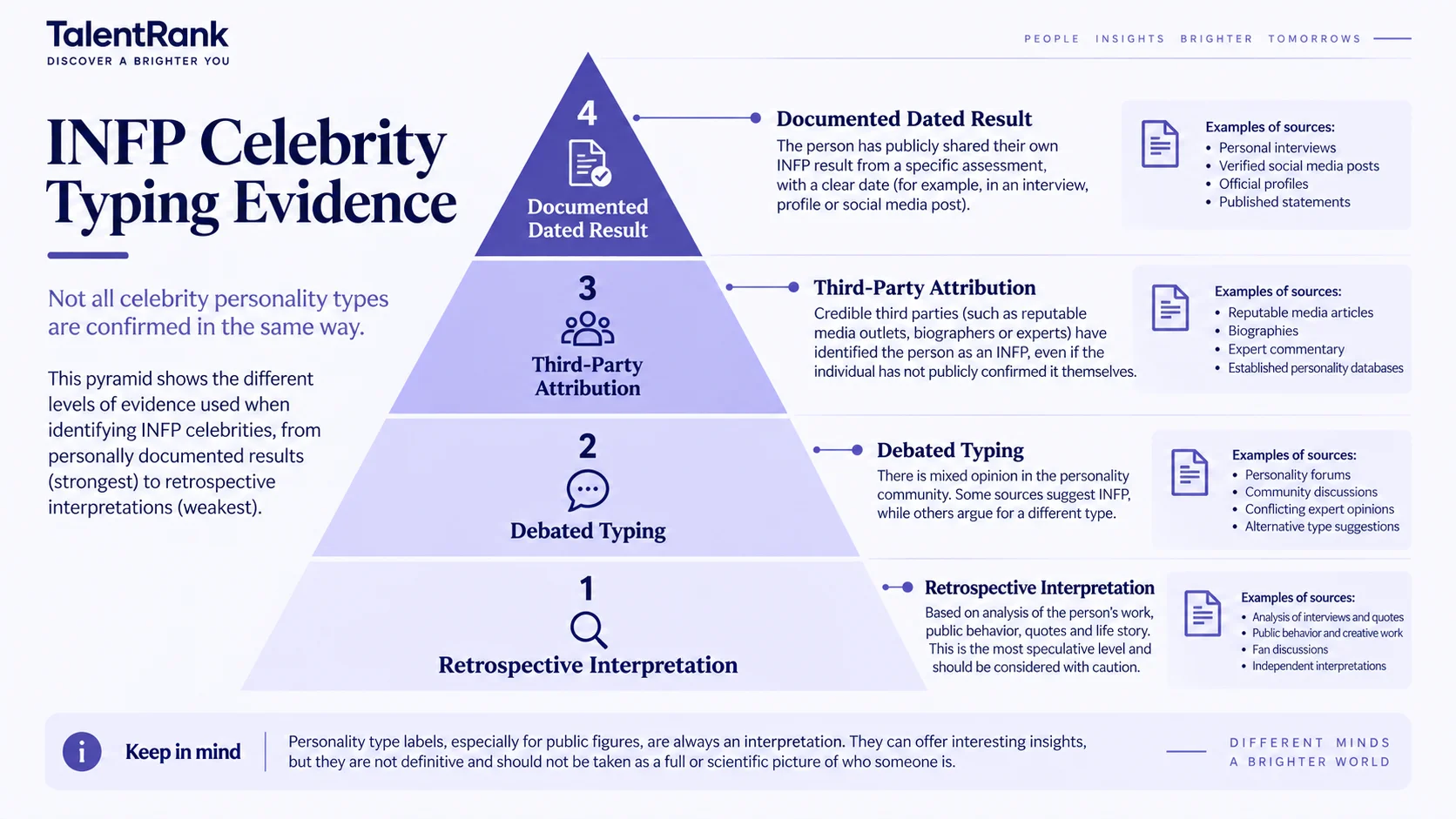
The evidence labels used in this guide
Documented or primary evidence: A reliable direct record reports the person's result or self-identification. Stephen Colbert's 2015 broadcast result is the clearest example in this article.
Attributed or third-party: Personality publications or databases repeatedly assign INFP, but we did not verify a direct result from the person.
Debated: Meaningful alternative typings exist, so presenting one label as settled would hide the disagreement.
Retrospective or historical: A modern label is applied to someone from an earlier period. It is an interpretation of a historical record, not a modern assessment result.
These labels measure the evidence behind the attribution, not the quality of the person or the “strength” of their personality.
Before Trusting an INFP Celebrity List
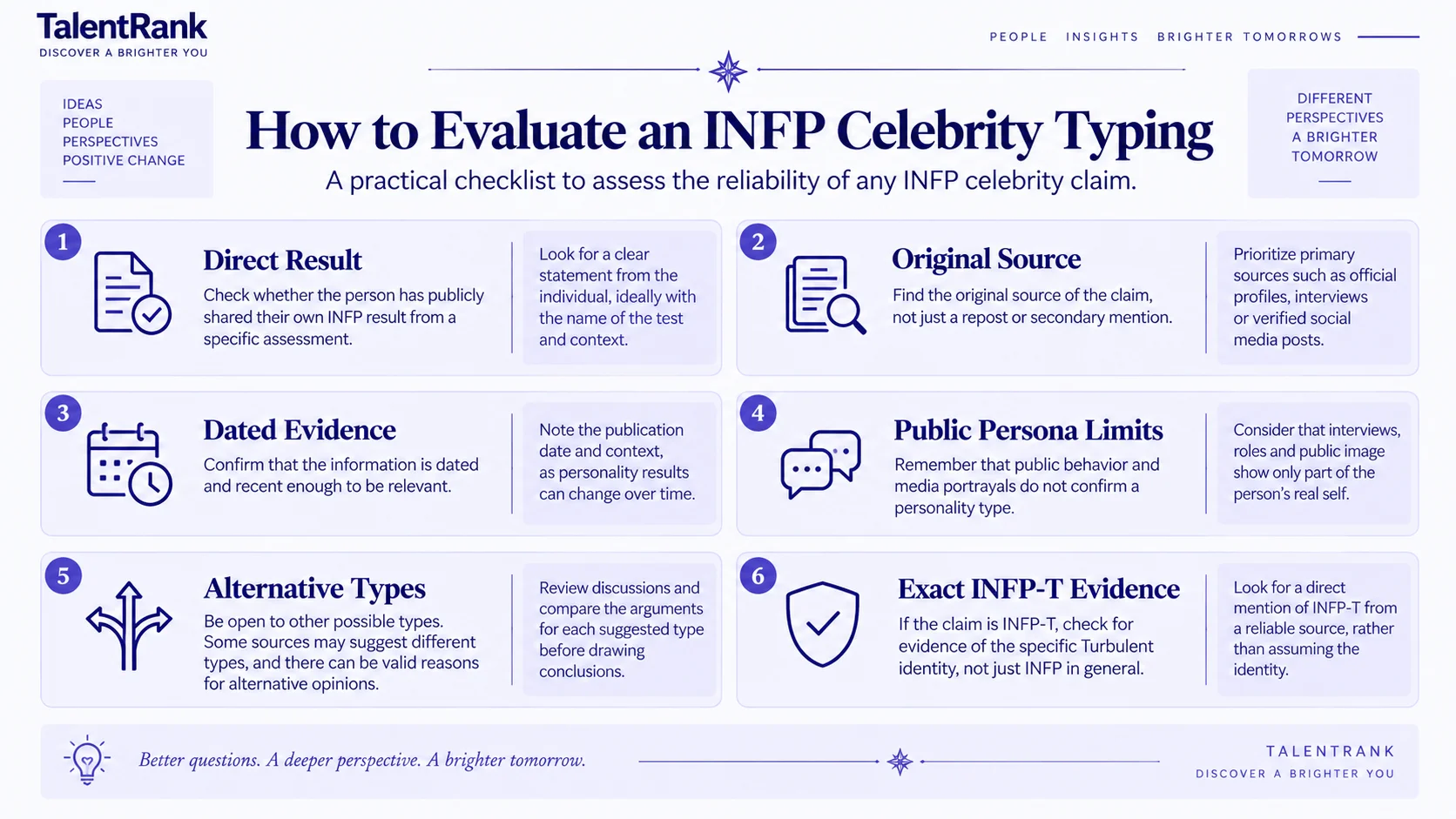
Before treating a celebrity typing as reliable, ask:
Is there a direct assessment result or self-report?
Is the label mainly repeated across personality databases?
Are interviews, lyrics, roles, or artistic style being treated as proof?
Is the person historical, making the typing necessarily retrospective?
Do credible alternative typings exist?
Is INFP-T being added without evidence for that exact subtype?
Does the wording distinguish “commonly typed” from “confirmed”?
This checklist evaluates the evidence behind a celebrity label. It is not a personality test or scoring system.
Celebrity examples can be interesting, but resemblance to a public figure does not establish your own personality type. If you want to explore your own trait patterns, TalentRank offers a broader personality assessment.
INFP Celebrities in Acting, Film, and Television
Stephen Colbert
Evidence status: Documented dated result
Among INFP celebrities, Stephen Colbert is unusually useful because there is a public assessment event rather than only retrospective analysis. In September 2015, The Late Show aired a segment in which a practitioner guided him through the result discussion and INFP was reported. The Myers-Briggs Company's own site also references Colbert taking the MBTI assessment on the show.
That still does not mean every aspect of his television persona should be reverse-engineered into INFP traits. Colbert spent years performing an intentionally constructed satirical character, and even his current hosting style is a performance. The documented event is stronger evidence than guessing from that performance.
Keanu Reeves
Evidence status: Attributed / third-party
Keanu Reeves is one of the most persistent names on lists of INFP celebrities. Current personality databases such as Boo label him INFP, and older celebrity-type articles do the same. Community discussions also show how readily fans associate him with the type.
What is missing is equally important: this research did not locate a reliable direct MBTI result from Reeves. Descriptions of him as private, humble, kind, or reflective may explain the attribution, but none proves the four preferences. Film roles are weaker evidence because they are performances.
The cautious description is simple: Keanu Reeves is commonly typed as INFP online, but the label should be treated as an attribution rather than a confirmed result.
Johnny Depp
Evidence status: Attributed / third-party
Johnny Depp also appears repeatedly in lists of INFP celebrities. Current databases including Boo and GetPersonality assign him INFP, while other personality articles point to his unusual creative choices and individualistic approach to acting.
Eccentric characters, unconventional projects, or privacy can fit many personality explanations, and Depp's roles cannot reveal his own preferences. Without a direct result, “commonly typed as INFP” is more accurate than “is an INFP.”
Andrew Garfield
Evidence status: Debated
Andrew Garfield is a useful example of disagreement. An older IDRlabs analysis presented him as an INFP and compared his interview style with INFJ patterns. Other current sources assign him ISFP, and additional interpretations circulate.
Interviews show how someone communicates in a particular setting, but observers can interpret the same behavior differently. Garfield therefore belongs in a debated category, not a confirmed list.
Audrey Hepburn
Evidence status: Retrospective / debated
Audrey Hepburn is regularly included among famous INFPs, but she is also typed as ISFP by current sources. Since Hepburn died in 1993, current online typings should be treated as retrospective unless a credible contemporaneous type record is available.
Her humanitarian work, public image, and career are not proof of INFP preferences. Hepburn is best described as a historical celebrity commonly interpreted as INFP, with a meaningful ISFP alternative.
Tim Burton
Evidence status: Attributed / third-party
Tim Burton is frequently included among INFP celebrities by personality databases, including current GetPersonality and Personality Index pages. His highly recognizable visual imagination makes him an appealing example for lists about creative personality types.
A gothic aesthetic or filmmaking career does not reveal a four-letter result. Burton is best treated as a widely attributed INFP celebrity, not proof that INFPs create a particular kind of art.
INFP Celebrities in Music
Among INFP celebrities, musicians may be the category where stereotypes become most tempting. Introspective lyrics, experimentation, privacy, emotional performances, and unconventional aesthetics can all make an artist look like a textbook example. Yet songs are creative works, not personality questionnaires.
Kurt Cobain
Evidence status: Retrospective / debated
Kurt Cobain appears on numerous lists of INFP celebrities, including long-running celebrity personality pages. His interviews and artistic record also give typology communities a large amount of material to interpret.
Consensus is far from complete. Current typology communities disagree, including arguments for ISFP and INFP. That disagreement is useful as a signal of uncertainty, not as scientific evidence. Repetition across lists should not be mistaken for verification.
It would also be inappropriate to use Cobain's health history, substance use, or circumstances of death as evidence for a personality type. Those issues are separate from whether a four-letter typology interpretation is persuasive.
Björk
Evidence status: Debated
Björk is another case where lists of INFP celebrities reveal how quickly online certainty can break down. Some databases and older lists call her INFP. A current Boo profile labels her INFJ, while community discussions include INFP, ENFP, INFJ, and other interpretations.
Her experimental creative process does not resolve the typing question. Björk is commonly discussed in INFP contexts but remains clearly debated.
Fiona Apple
Evidence status: Attributed / debated
Fiona Apple is frequently included among INFP celebrities and is labeled INFP by GetPersonality, and an older Typology Central poll also favored INFP among participants. That makes the attribution easy to document as a community consensus in particular spaces.
A community vote is not psychological evidence, and Apple's lyrics are not a personality test. “Frequently typed as INFP” is the appropriate level of certainty.
Thom Yorke
Evidence status: Attributed / debated
Radiohead's Thom Yorke is another recurring name among INFP celebrities. GetPersonality and Personality Index currently display INFP, while typology discussions have argued for INTP and INFJ as well.
Abstract lyrics and experimental music do not uniquely indicate one type. Yorke can reasonably appear among commonly typed INFP celebrities if competing interpretations remain visible.
INFP Celebrities in Writing, Art, and History
Historical INFP celebrities need a different standard because modern typology is being applied backward. Letters, diaries, biographies, interviews, and archives can tell us a great deal about a person's life. They cannot recreate a modern assessment session.
J.R.R. Tolkien
Evidence status: Retrospective / debated
J.R.R. Tolkien is widely included in historical lists of INFP celebrities, but recent evidence-aware analysis illustrates why the label should stay tentative. TypeAtlas reviewed material from the Tolkien Estate and Bodleian collections and rated its own INFP hypothesis low confidence, naming INFJ or INTJ as alternatives.
Typing Tolkien simply because he created an imaginative fantasy world would be weak evidence. His work supports discussion, not confirmation.
Virginia Woolf
Evidence status: Retrospective
Virginia Woolf appears among historical INFP celebrities in current personality databases and older famous-person lists. Because she died in 1941, the modern four-letter label is necessarily retrospective unless an extraordinary contemporaneous record were discovered.
Her diaries, essays, novels, and biography provide material for interpretation, not evidence that Woolf completed or verified an MBTI result.
George Orwell
Evidence status: Retrospective
George Orwell is likewise included among historical INFP celebrities by modern personality databases. Commentators often connect his moral commitments and writing to a values-led interpretation.
His writing and biography can inform an editorial hypothesis, but they do not establish a modern personality result.
Edgar Allan Poe
Evidence status: Retrospective
Edgar Allan Poe is a staple of many lists of historical INFP celebrities. Current databases continue to label him INFP, and some sites use the intensity or symbolism of his writing as part of the rationale.
Poe died in 1849, so gothic subject matter or poetic style cannot confirm a modern personality type. His inclusion is a retrospective interpretation.
Vincent van Gogh
Evidence status: Retrospective
Vincent van Gogh is another frequently cited name among historical INFP celebrities. Personality databases assign the label, while his letters and art provide extensive source material for biographical interpretation.
Rich records do not remove the historical limitation. A painting is not an assessment response. Van Gogh can be discussed as commonly typed INFP, not as a confirmed case.
Which INFP Celebrities Are Best Documented, and Which Are Debated?
The evidence is uneven. That is the central finding of this review.
Person | Why the INFP label appears | Evidence category | Main uncertainty |
Stephen Colbert | 2015 practitioner-led broadcast result | Documented dated result | Dated result does not define every public persona or future result |
Keanu Reeves | Repeated celebrity lists and databases | Attributed | No direct result verified here |
Tim Burton | Repeated database/list attribution | Attributed | Artistic style is not assessment evidence |
Fiona Apple | Database label and community preference | Attributed / debated | Community voting is not confirmation |
Kurt Cobain | Long-standing list attribution | Retrospective / debated | Strong ISFP counterarguments exist |
Björk | Long-running INFP attribution | Debated | Current sources disagree materially |
Andrew Garfield | INFP analyses exist | Debated | Current ISFP and other alternatives exist |
Audrey Hepburn | Frequently included in INFP lists | Retrospective / debated | ISFP is also commonly proposed |
J.R.R. Tolkien | Long-standing historical attribution | Retrospective / debated | Recent evidence review rates INFP hypothesis low confidence |
Stephen Colbert stands apart in this article because a dated public INFP result is documented. For most other names, the responsible language remains “commonly typed,” “often attributed,” or “debated.”
Celebrity typing relies on limited public evidence. If the real question is about your own personality, information about your own preferences is more relevant than trying to match yourself to a famous person. You can explore TalentRank's broader personality assessment for first-person self-reflection.
What About INFP-T Celebrities?
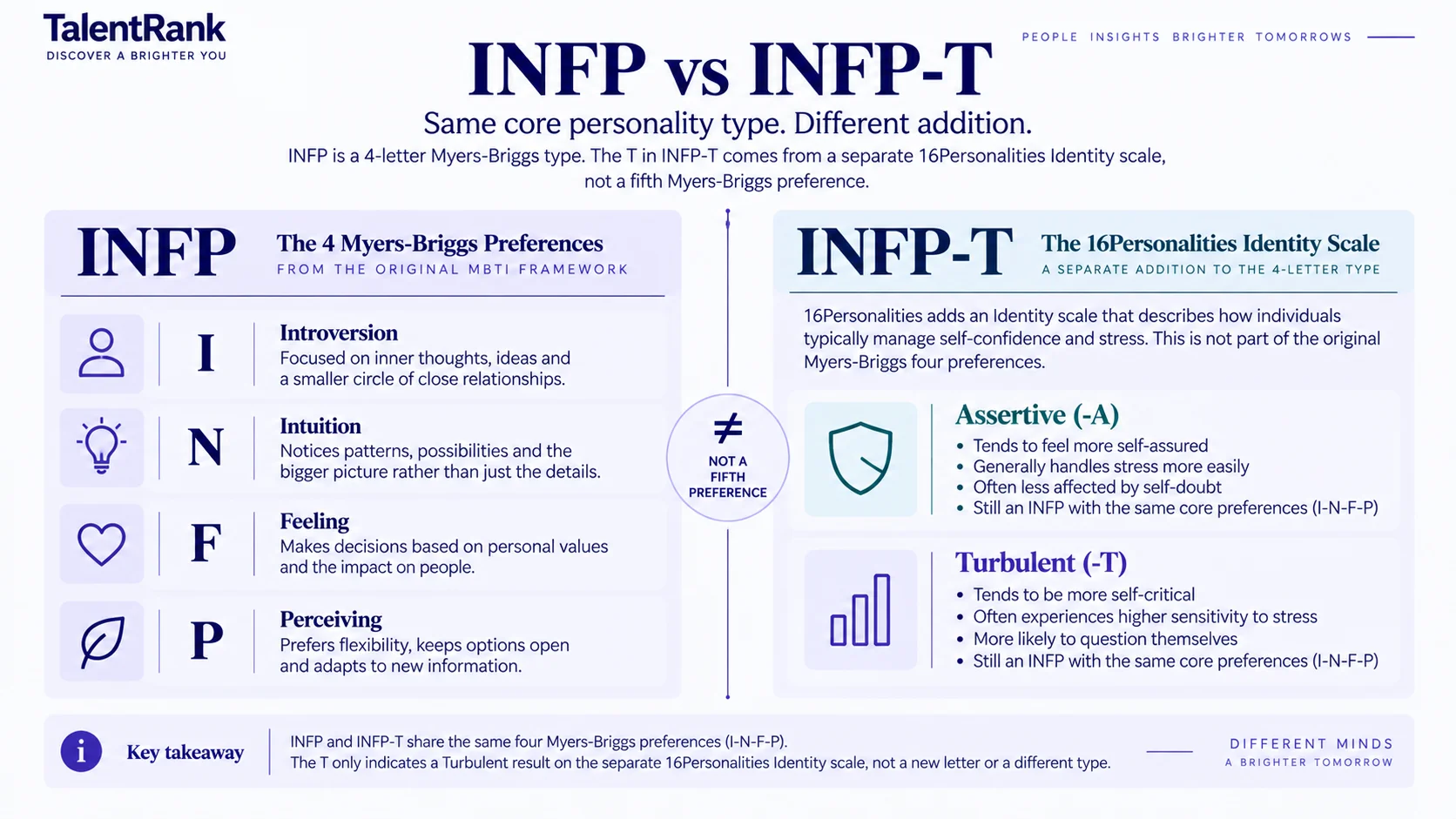
INFP-T celebrities are people described as INFP with a Turbulent identity in the 16Personalities framework. The -T should not be automatically added to someone merely because another source calls them INFP.
This distinction matters because the Myers-Briggs framework and 16Personalities do not use identical type structures. Myers-Briggs describes four preference pairs. 16Personalities explicitly adds a fifth dimension called Identity, expressed as Assertive (-A) or Turbulent (-T).
As a result, a page that labels Keanu Reeves or Kurt Cobain “INFP” has not established that the person is specifically INFP-T. A reliable exact result or source would be needed for that stronger claim. During this research, we did not verify adequate direct evidence to build a trustworthy list of named INFP-T celebrities, so this article does not manufacture one.
That may be less exciting than a long list, but it is more useful. Search phrases such as infp t celebrities and infp t personality celebrities often lead to pages where related personality systems are blended together without explaining the distinction.
Why Celebrity Personality Typing Is Easy to Get Wrong
Creativity does not automatically mean INFP
Artists are heavily represented on INFP lists, but creative ability is not exclusive to any personality type. A filmmaker's visual style, a musician's experimental sound, or an author's imaginative world can be evidence of artistic choices without telling us which preference pair best describes the person.
Privacy does not prove Introversion
A celebrity can dislike publicity for many reasons. Likewise, someone can be energetic onstage and still prefer Introversion. Public visibility and psychological preference are not the same thing.
A public persona is incomplete
Interviews are edited. Performances have goals. Social media is curated. Actors play characters, musicians write from perspectives other than their own, and public figures learn how to communicate with audiences. Typing from those fragments always has limits.
Different sources use different assumptions
One database may emphasize community voting. Another writer may focus on cognitive-function theory. A third may use broad trait stereotypes. That is why the same person can appear as INFP on one site and ISFP, INFJ, ENFP, or another type elsewhere.
The disagreement is not a flaw that needs to be hidden. It is information about how uncertain the inference is.
Frequently Asked Questions
Who are some famous people commonly typed as INFP?
Stephen Colbert, Keanu Reeves, Johnny Depp, Tim Burton, Kurt Cobain, Fiona Apple, Thom Yorke, J.R.R. Tolkien, Virginia Woolf, and Vincent van Gogh are among people commonly associated with INFP in personality content. Evidence varies substantially, however. Colbert has a documented 2015 result, while many others are third-party or retrospective attributions.
Which actors are commonly typed as INFP?
Keanu Reeves and Johnny Depp are frequently typed as INFP by celebrity personality sites. Audrey Hepburn and Andrew Garfield also appear in INFP discussions, although both have meaningful alternative typings in current sources. These labels should describe internet attribution, not an assumption that the actors publicly verified an INFP result.
Which musicians are commonly typed as INFP?
Kurt Cobain, Fiona Apple, Thom Yorke, Björk, and Alicia Keys frequently appear in INFP celebrity discussions. Their evidence is mostly interpretive rather than direct. In particular, Cobain and Björk attract substantial disagreement, showing why lyrics, artistic experimentation, privacy, or emotional expression should not be treated as a personality assessment.
Is Kurt Cobain considered an INFP?
Kurt Cobain is commonly typed as INFP on celebrity personality lists, but the attribution is debated. Recent typology discussions argue for ISFP, among other alternatives, and this review did not verify a direct MBTI result from Cobain. His health history or circumstances of death should not be used as evidence for either type.
Is Keanu Reeves an INFP?
Keanu Reeves is commonly labeled INFP by current personality databases and celebrity-type articles, but this review did not verify a direct public MBTI result from him. His reputation for privacy, kindness, or humility may influence online interpretations, but those qualities do not establish a type. “Commonly typed as INFP” is the safer description.
Are there any confirmed INFP celebrities?
Stephen Colbert provides unusually strong public evidence: a practitioner-led 2015 Late Show segment reported an INFP result, and the Myers-Briggs Company references his assessment. Even here, “documented dated result” is more precise than treating type as an immutable fact. Most other celebrity labels in this article are attributed, debated, or retrospective.
What are INFP-T celebrities?
INFP-T celebrities are public figures described using the Turbulent (-T) Identity label from the 16Personalities framework. Myers-Briggs itself uses four preference pairs rather than that fifth A/T dimension. Therefore, a celebrity being called INFP does not automatically make them INFP-T. Exact subtype claims require evidence for that specific result.
Can you accurately type a celebrity from interviews?
Interviews can provide material for an interpretation, but they rarely justify certainty. Public figures may be performing, promoting a project, responding to editing, or showing only a narrow part of themselves. Interviews are more useful when combined with direct self-report and reliable context, and even then they should not be treated as diagnosis.
Why do personality websites disagree about celebrity MBTI types?
Personality websites use different evidence and assumptions. Some rely on community votes, others interpret interviews, and others apply cognitive-function or trait frameworks. Public evidence is incomplete, so reasonable observers can reach different conclusions. A useful celebrity list should expose that uncertainty instead of hiding it behind a definitive four-letter label.
Final Takeaway
The most useful way to read lists of INFP celebrities is as a map of common interpretations, not a roster of proven psychological facts. Stephen Colbert has an unusually well-documented dated INFP result, while figures such as Keanu Reeves, Kurt Cobain, Björk, Audrey Hepburn, and Tolkien illustrate different levels of attribution, debate, and historical uncertainty.
Celebrity examples can make personality frameworks easier to discuss. For a separate look at fictional rather than real-person typing, see TalentRank's INFP characters guide. Similarity to a favorite actor, musician, writer, or character does not establish your own type. Pay attention to the quality of the evidence, keep competing interpretations visible, and use personality frameworks as tools for reflection rather than destiny.