
You use cognitive skills whenever you follow a conversation, hold instructions in mind, compare options, learn a new tool, or adjust when a plan changes. The phrase can sound technical, but it describes mental processes involved in ordinary tasks, not a single score, a fixed label, or a judgment about someone's career potential.
This guide gives a practical cognitive skills definition, explains six common types, and shows how they work together on the job. You will also learn how cognitive skills differ from IQ, knowledge, and personality; what assessments can and cannot tell you; and how to map a real work task without turning reflection into a homemade test.
What Are Cognitive Skills?
Cognitive skills are mental processes people use to pay attention, remember information, reason, learn, adapt, and manage tasks. These processes work together rather than in isolation. Different psychological and educational frameworks group them differently, so no single list of cognitive skills should be treated as universally definitive.
The APA Dictionary of Psychology describes cognitive ability in terms of skills involved in perception, learning, memory, understanding, reasoning, judgment, and language. Cleveland Clinic similarly presents cognition as a broad set of processes that includes learning, attention, memory, decision-making, reasoning, problem-solving, and language.
In everyday language, a cognitive skill is not the same thing as knowing a fact or mastering a specific software package. Knowledge supplies information; cognitive processes help you notice, hold, retrieve, compare, and use that information. The European Commission's Joint Research Centre also distinguishes knowledge from skills, while noting that terminology varies across disciplines and industries.
Why Lists of Cognitive Skills Vary
A clinic, a school, a researcher, and an employer may organize cognition differently because they are asking different questions. A clinician may examine memory, language, and attention as part of a health evaluation. An educator may focus on learning and transfer. A workplace assessment may emphasize reasoning, perceptual speed, or role-relevant problem-solving.
That means a list with four categories is not automatically more scientific than a list with ten. What matters is whether the categories are clearly defined and appropriate for the purpose. For this workplace-focused guide, six broad categories provide a useful map without pretending to be the only valid model.
Important context: Cognitive-skill taxonomies vary by framework and purpose. The six-category model below is a practical organizing tool, not a universal diagnostic classification.
Main Types of Cognitive Skills
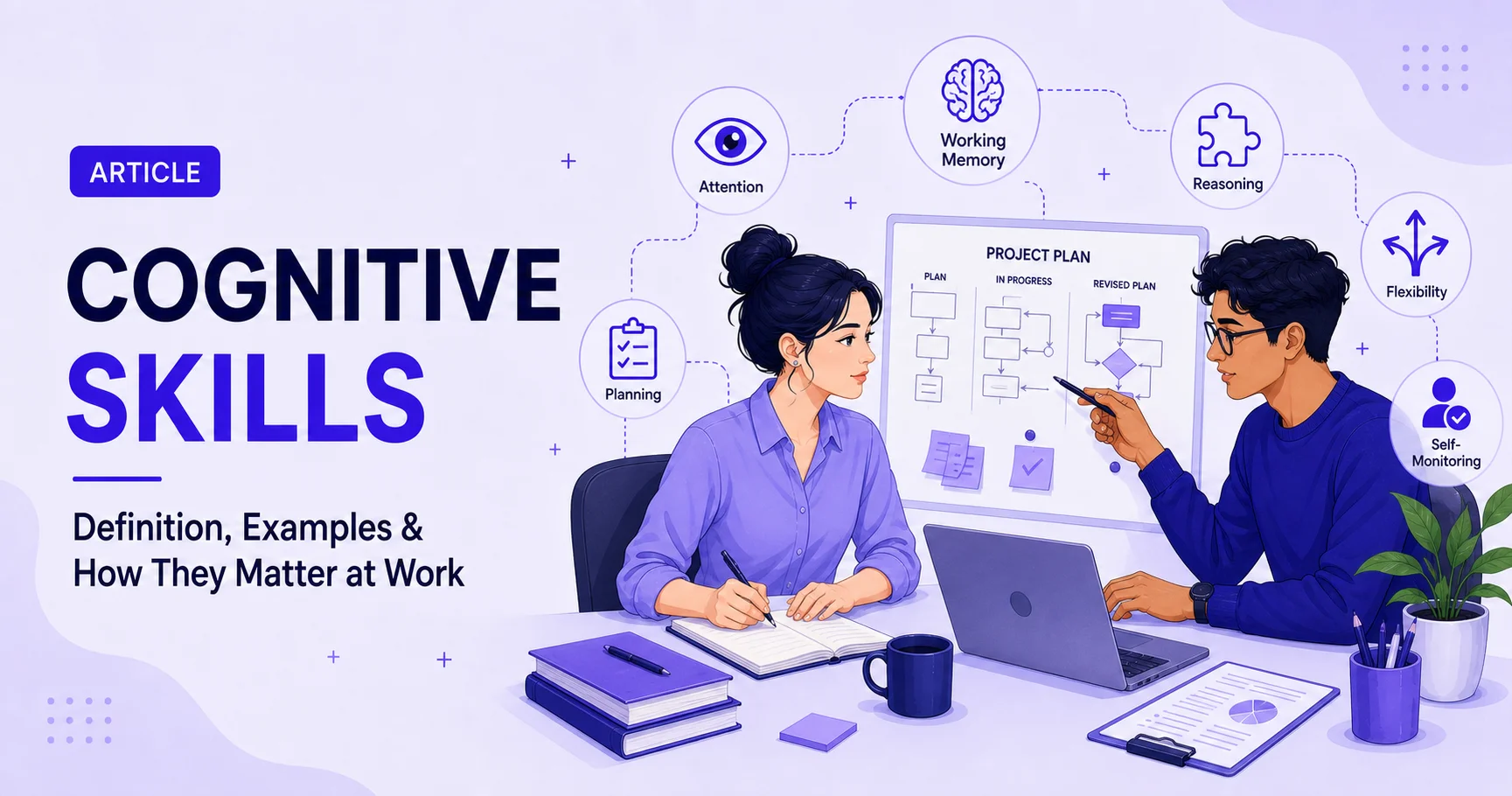
Common cognitive skills include attention, working memory, processing speed, reasoning and problem-solving, cognitive flexibility, and planning or self-monitoring. These categories overlap: a real task may require several at once. The list below is a practical workplace framework, not a diagnostic checklist or a claim that every expert uses identical categories.
Attention
Attention helps you select what matters and stay engaged with it long enough to act. At work, it may involve listening for a client's main constraint, checking a spreadsheet for a specific discrepancy, or returning to a priority after an interruption.
Attention is not simply “trying harder.” Task clarity, competing demands, notifications, noise, fatigue, familiarity, and available tools can all shape what focused performance looks like. One missed detail does not establish a permanent attention problem.
Working Memory
Working memory lets you hold task-relevant information in mind while using or updating it. The National Institute of Mental Health defines it as the active maintenance and flexible updating of goal-relevant information, with limited capacity and resistance to interference.
You use working memory when you translate several spoken instructions into an action plan, calculate a change while remembering the original figure, or connect a new comment to an earlier part of a meeting. Notes and checklists reduce the amount that must remain active in mind; using them is task design, not evidence of weak ability. For a deeper distinction, see working memory and IQ.
Processing Speed
Processing speed concerns how efficiently someone can take in, interpret, and respond to information under particular conditions. It can matter when scanning familiar records, matching information, or completing a time-sensitive routine.
Faster is not always better. A novel, ambiguous, or high-stakes decision may deserve deliberate thinking. Accuracy requirements, experience, interface design, language, and time pressure affect performance, so speed should be interpreted in relation to the task rather than treated as a universal measure of quality.
Keep in mind: Speed and quality are different questions. Interpret speed only in relation to the task, accuracy requirement, and conditions.
Reasoning and Problem-Solving
Reasoning helps you identify relationships, compare evidence, form conclusions, and work through unfamiliar problems. Problem-solving adds a goal: define what is wrong, identify constraints, consider options, try a response, and evaluate the result.
Domain knowledge still matters. Someone who understands a product, regulation, or customer group can notice patterns that a newcomer may miss. Strong general reasoning does not instantly replace the experience required to make sound decisions in a specialized field.
Cognitive Flexibility
Cognitive flexibility is the capacity to shift perspectives, rules, strategies, or priorities when circumstances change. It appears when you revise a plan after receiving new information, switch between two task requirements, or recognize that the first solution is not working.
A major review of executive functions identifies working memory, inhibitory control, and cognitive flexibility as closely related core processes. Flexibility does not mean changing direction constantly; it means adjusting when the evidence or task demands justify it.
Planning and Self-Monitoring
Planning turns a goal into a sequence of actions, while self-monitoring helps you check progress and notice when an approach needs correction. These processes sit within the broader family of executive functions, which the NCBI MeSH definition describes as cognitive functions that control complex, goal-directed thought and behavior.
At work, planning and self-monitoring may involve estimating dependencies, setting checkpoints, comparing current output with the requirement, and revising the next step. They often depend on attention, working memory, and flexibility rather than operating as isolated skills.
Cognitive Skills vs. Cognitive Abilities, IQ, Knowledge, and Personality
The terms overlap, but they are not interchangeable. Cognitive skills describe mental processes used during tasks; cognitive abilities describe broader capacities examined across tasks; IQ summarizes performance on selected cognitive tests; knowledge is learned information; and personality describes characteristic patterns of thought, feeling, and behavior rather than cognitive performance itself. Readers who want the broader theory-level view can explore types of intelligence frameworks.
Term | Plain meaning | Workplace example | What it does not establish |
Cognitive skills | Mental processes used while completing tasks | Holding changing requirements in mind while revising a plan | A complete cognitive profile from one task |
Cognitive abilities | Broader capacities inferred from relevant tasks or measures | Reasoning across several standardized problems | Every condition shaping real work |
IQ | A standardized summary from a defined set of cognitive test performances | A score interpreted against the instrument's comparison group | All knowledge, skill, motivation, personality, or life outcomes |
Knowledge | Facts, concepts, procedures, and understanding learned through experience or education | Knowing the rules and terminology of a regulated process | How someone will handle every unfamiliar problem |
Personality | Characteristic tendencies in thought, feeling, and behavior | A tendency to prepare carefully or seek discussion | Cognitive ability or task performance by itself |
Executive function | Control processes supporting goal-directed behavior | Planning, monitoring, inhibiting distractions, and changing approach | Every cognitive process |
Terminology varies across fields, so these are practical boundaries rather than claims that every framework uses the words identically. The same visible behavior can also have different explanations. A person may pause before answering because the problem is unfamiliar, the instructions are unclear, they are checking for accuracy, or they prefer a deliberate approach. Behavior needs task and context before it becomes useful evidence.
How Cognitive Skills Show Up in Everyday Work
Cognitive skills appear in the mental demands of ordinary tasks. Following a changing brief may involve attention, working memory, flexibility, and planning; learning new software may involve memory and reasoning; comparing options under time pressure may involve processing speed and judgment. Context and prior knowledge also affect what performance looks like.
Following a Changing Project Brief
Imagine that a client changes the audience, deadline, and approval process halfway through a project. Attention helps identify what changed. Working memory connects the new requirements to the existing plan. Cognitive flexibility supports abandoning assumptions that no longer apply. Planning turns the revised brief into new tasks and dependencies.
Useful evidence would be the updated scope, questions raised, risks identified, and sequence of next actions. Finishing quickly is not the only sign of effective cognition; pausing to confirm an ambiguous requirement may prevent expensive rework.
Learning a New Software Workflow
When someone learns new software, they must notice interface cues, remember steps, connect actions with outcomes, and retrieve the sequence later. Existing knowledge can reduce the load. A person familiar with similar systems may learn faster because parts of the workflow already make sense.
Good support can change performance: a short demonstration, a searchable guide, practice on realistic cases, and a checklist for infrequent procedures. Those supports do not invalidate skill. They become part of a reliable workflow.
Comparing Options Under Time Pressure
Suppose a team must choose among three suppliers before a deadline. The task may require retrieving criteria, comparing costs and risks, ignoring irrelevant detail, and deciding when the evidence is sufficient.
Processing speed matters, but so do reasoning and self-monitoring. A fast choice based on the wrong criterion is not better than a slightly slower choice that satisfies the actual requirement. A clear decision matrix can make the task more consistent by keeping criteria visible.
Use the Cognitive Skills at Work Map
The Cognitive Skills at Work Map is a reflection tool for translating a real task into mental demands and observable evidence. It is not a psychometric test, diagnostic instrument, or hiring score. Its purpose is to replace vague self-labels with a more useful question: what did this task require, and what actually happened?
Reflection tool, not a cognitive test: Do not assign points, ratings, percentiles, or result categories. The map organizes observations from one task under stated conditions.

Several cognitive processes can support one workplace task. The map keeps evidence and context visible without creating a score.
Worksheet field | What to record |
Real task | A specific activity with a clear beginning and outcome |
Goal and constraints | What needed to happen, by when, and within which limits |
Mental demands | What needed attention, memory, reasoning, flexibility, speed, planning, or monitoring |
Possible cognitive skills | Tentative labels that help organize the task, not a diagnosis |
Observable evidence | Questions asked, decisions documented, errors caught, or steps completed |
Context and support | Prior knowledge, tools, instructions, collaboration, interruptions, and time pressure |
One small experiment | A single change to try during the next comparable task |
What this does not prove | The limits of the observation and what cannot be inferred from it |
Step 1: Choose One Real Task
Select a specific task with a clear beginning and outcome. “Manage projects” is too broad. “Revised the launch plan after the delivery date changed” is specific enough to examine.
Write down:
the task;
the goal;
the main constraints;
what counted as a useful outcome.
Step 2: Separate the Task From the Skill Label
Describe what the task required before choosing labels. For example: “I had to identify three changed requirements, keep the original dependencies visible, and reorder the next actions.” This is more informative than starting with “I used strong cognitive skills.”
Step 3: Identify the Mental Demands
Ask which processes may have been involved:
What needed attention?
What information had to remain active or be retrieved?
What relationships or options required reasoning?
Did the rules, priorities, or perspective change?
Was speed important, and what accuracy level was required?
How was progress checked?
Treat these as possible demands, not a diagnosis of the person completing them.
Step 4: Record Evidence and Context
Capture observable evidence: updated notes, questions asked, errors caught, decisions documented, or steps completed. Then record context, such as prior experience, tools, interruptions, time pressure, instructions, collaboration, or support.
Context prevents overinterpretation. A difficult first attempt with unfamiliar software does not establish a fixed limitation. A smooth attempt with a strong checklist does not prove that the task would be equally easy under every condition.
Step 5: Choose One Small Work Experiment
Change one part of the task and observe the next attempt. You might create a checklist, block notifications for 25 minutes, restate the decision criteria, request a worked example, or practice the exact workflow on another realistic case.
The goal is not to produce a cognitive score. It is to learn which conditions and strategies support reliable task performance.
Worked Example: A Revised Client Brief
Illustrative example: This fictional scenario shows how to use the map. It is not a customer case study or assessment result.
Real task: Update a campaign plan after the client changes the audience and deadline.
Mental demands: Notice the changes, connect them to existing dependencies, revise assumptions, and sequence new actions.
Possible cognitive skills: Attention, working memory, reasoning, cognitive flexibility, planning, and self-monitoring.
Observable evidence: A change log, three clarified questions, a revised timeline, and documented approval points.
Context: The original brief remained available, but the new instructions arrived across two messages. The deadline created moderate time pressure.
Small experiment: Consolidate all changes into a one-page checklist before revising the plan.
What this does not prove: The example does not measure a stable cognitive ability or predict performance in unrelated tasks. It only organizes evidence about one task under stated conditions.
Can Cognitive Skills Be Improved?
People can improve performance on many practiced cognitive tasks by learning strategies, building relevant knowledge, and changing the work environment. However, improvement does not always transfer broadly to unrelated tasks. Brain games or repeated exercises should not be presented as guaranteed ways to raise every cognitive skill or improve job performance.
Practice Usually Improves the Practiced Task
Repeated, relevant practice can make a procedure more familiar and reduce the amount of conscious effort needed for each step. Feedback can help someone correct errors. Domain knowledge can make patterns easier to recognize. External tools can reduce avoidable memory or attention demands.
Practical examples include:
rehearsing the actual workflow rather than an unrelated puzzle;
repeating and reviewing the exact information needed for the task;
breaking complex instructions into visible steps;
creating checklists for infrequent or high-risk procedures;
reducing unnecessary interruptions during concentrated work;
reviewing errors to identify which part of the process needs support.
These approaches aim to improve a task and its conditions. They do not establish a general increase in intelligence.
Why Transfer to Unrelated Tasks Is Not Guaranteed
Improvement on one exercise may remain specific to that exercise or to closely related situations. The National Academies chapter on assessing cognitive skills explains that complex strategies do not automatically transfer from one domain to another and that meaningful context and explicit support may be needed.
This is why a high score in a brain-training game should not be treated as proof of broad workplace improvement. A better question is whether the practiced strategy transfers to the real task that matters, and whether that change is observable under realistic conditions.
Keep in mind: Better performance on a practiced exercise does not guarantee broad improvement on unrelated work or daily tasks.
When a Sudden Cognitive Change Needs Professional Context
Ordinary variation in focus or performance is not the same as a medical condition. However, a sudden change in confusion, speech, understanding, awareness, or thinking can require urgent medical attention. The National Institute on Aging lists sudden confusion and difficulty speaking or understanding speech among stroke warning signs and advises calling 911 immediately.
For non-emergency but persistent or concerning changes, a qualified healthcare professional can evaluate the person's history and circumstances. A workplace article, self-reflection worksheet, or employment assessment cannot diagnose the cause.
Urgent health note: Sudden confusion or difficulty speaking or understanding speech can be an emergency. Call 911 for immediate medical help.
How Are Cognitive Skills Measured?
Cognitive skills can be examined through performance tasks, standardized ability tests, structured workplace assessments, or clinical screening tools, depending on the purpose. These methods are not interchangeable. A score reflects performance under particular conditions and should be interpreted with role relevance, context, and other evidence, not as a diagnosis or complete career verdict. For more detail about score scope, see what IQ tests measure.
Performance Tasks, Ability Tests, and Clinical Screening
Method | Main purpose | What the reader sees | Important limit |
Work sample or performance task | Observe performance on a relevant activity or simulation | What happened on that task under stated conditions | One task does not establish a complete cognitive profile |
Standardized cognitive-ability test | Examine defined constructs through standardized tasks | Scores interpreted using the instrument's rules and comparison data | Results depend on purpose, construct, conditions, and appropriate interpretation |
Clinical screening or evaluation | Address a health-related question | History, observation, measures, and qualified professional interpretation | It is not interchangeable with a pre-employment test or self-reflection worksheet |
The U.S. Equal Employment Opportunity Commission distinguishes cognitive tests from work samples, personality tests, and medical examinations. It also explains that employment procedures may raise discrimination issues and should be job-related and consistent with business necessity when the law requires that justification.
Why One Score Is Not a Complete Career Verdict
A score can be informative only in relation to its purpose, the construct measured, administration conditions, comparison group, and the task or role. It cannot summarize motivation, values, personality, experience, knowledge, health, opportunity, or every condition that shapes real work.
Assessment information should be considered alongside other job-relevant evidence, such as structured interviews, work samples, experience, and documented job requirements. It should not be stretched beyond the purpose for which the instrument was designed. The Cognitive Skills at Work Map in this article adds reflection and context; it does not produce an assessment result.
TalentRank's assessment overview describes a brief ICAR-based cognitive screening combined with Big Five personality for self-reflection and career exploration. It is not a clinical IQ test, diagnosis, or sole basis for a high-stakes decision.
Assessment limit: One score is not a diagnosis or a complete career verdict. Interpret it only for its stated purpose and alongside other relevant evidence.
How to Describe Cognitive Skills on a Resume or in an Interview
Describe cognitive skills through task, action, and outcome evidence instead of listing unsupported labels. The evidence does not need to prove a permanent trait; it needs to show how you approached a relevant situation and what happened.
Use this pattern:
Task: What needed to be done?
Demand: What made it mentally challenging?
Action: What did you notice, compare, organize, learn, or change?
Support: Which tools, information, or collaboration helped?
Outcome: What observable result followed?
Evidence Checklist
Is the task specific?
Is the mental demand clear?
Does the action describe what you actually did?
Are tools or collaboration acknowledged where relevant?
Is the outcome observable?
Does the example avoid claiming a permanent trait from one event?
Weak version: “Excellent cognitive and problem-solving skills.”
Stronger version: “Compared three supplier options against cost, delivery, and compliance requirements, documented the tradeoffs, and gave the project team a decision-ready recommendation before the purchasing deadline.”
The stronger version gives an interviewer something concrete to explore. It also avoids claiming that one example proves performance in every context. Cognitive demands are only one part of career fit; interests, personality, practical constraints, and work values also matter.
Frequently Asked Questions
Are cognitive skills the same as intelligence?
No. Cognitive skills are processes used for tasks such as attention, memory, reasoning, and adaptation. Intelligence is a broader theoretical construct, while an IQ score summarizes performance on a defined set of cognitive tests. The concepts overlap, but neither term captures all knowledge, personality, motivation, experience, or real-world performance.
Are cognitive skills hard skills or soft skills?
Cognitive skills do not fit neatly into the hard-skill/soft-skill split. They support both. Reasoning may help someone debug code, while attention and flexibility may support a difficult conversation. A technical skill is usually tied to a method or domain; a cognitive process can contribute across many tasks, with results shaped by context and knowledge.
Is memory a cognitive skill?
Yes. Memory is a major part of cognition, but it includes different processes. Working memory keeps and updates task-relevant information for immediate use, while long-term memory supports later retrieval of knowledge and experience. Remembering a familiar procedure and holding new instructions in mind are related but not identical demands.
Can personality affect how cognitive skills are used?
Personality may influence how someone typically approaches a task, for example, whether they seek stimulation, prefer preparation, persist with detail, or discuss an idea aloud. It does not replace cognitive skill or determine ability. Similar performance can come from different approaches, and the same person may behave differently across roles, incentives, and conditions.
Can brain games improve cognitive skills?
Brain games can improve performance on the games themselves and sometimes on closely related tasks, but broad transfer to unrelated work or daily activities is not guaranteed. Evaluate any claim by asking what improved, how it was measured, whether an active comparison group was used, and whether independent research found meaningful real-world transfer.
The Takeaway
Cognitive skills help people pay attention, remember, reason, adapt, and manage goal-directed tasks, but they do not operate alone or reduce a person to one score. The most useful way to understand them at work is to start with a real task, identify its mental demands, record observable evidence and context, and test a practical support or strategy. That approach produces better reflection, stronger resume examples, and more responsible assessment conversations than vague labels or unsupported claims.