


You prepare for an opportunity, tell yourself it matters, and still do something that moves you away from it. You delay the application, keep editing finished work, stay silent in an important meeting, or quit after one difficult week. From the outside, this can look like laziness or low ambition. From the inside, it often feels like protection from failure, criticism, conflict, or uncertainty.
These repeated actions are often described as self-sabotaging behavior. Recognizing them does not mean blaming yourself or diagnosing a mental health condition. It means noticing the gap between what you want and what you repeatedly do. For practical self-reflection, this article groups common behaviors into five patterns and explains how they may appear at work.
Key Takeaways
- Self-sabotage describes repeated behavior that works against a goal you genuinely want.
- This article uses five practical patterns: perfectionism, procrastination, quitting too soon, negative self-talk, and avoidant communication.
- Personality traits may shape how a behavior appears, but they do not determine your actions or future.
- Big Five, MBTI, personality, and IQ tests are not designed to diagnose self-sabotage.
- A small, specific replacement action can help interrupt each pattern.
What Is Self-Sabotage?
Self-sabotage is a general term for repeated thoughts or behaviors that move you away from a goal you sincerely value. It can include delaying action, setting impossible standards, leaving too early, dismissing your ability, or avoiding a necessary conversation. The behavior may reduce discomfort for a short time while creating a larger cost later.
You may want a promotion but avoid speaking about your results. You may want to finish a project but spend so long improving small details that you miss the deadline. You may want a better job but keep finding reasons not to apply.
The key question is not whether you made one poor choice. A pattern becomes clearer when the same response keeps producing the same unwanted result.
Procrastination, one possible form of self-sabotaging behavior, is often studied as a problem of self-regulation. Researchers also connect it with short-term emotion management. Avoiding a difficult task may briefly reduce boredom, fear, confusion, or worry, even when the delay creates more pressure later.
How Can You Tell Whether You Are Self-Sabotaging?
You may be working against yourself when your repeated actions conflict with a goal you genuinely value. Common signs include delaying important tasks, setting standards that make completion unlikely, withdrawing after small setbacks, dismissing useful feedback, or avoiding direct communication. One mistake does not prove a pattern; repetition and consequences matter more.
Ask yourself three questions:
- What result do I say I want?
- What do I repeatedly do when progress becomes uncomfortable?
- Does that behavior move me closer to the result, or protect me from a difficult feeling?
The answers may reveal a gap between your stated goal and your usual response.
What Are the Five Self-Sabotage Patterns Used in This Article?
For practical self-reflection, this article groups common self-sabotaging behaviors into five patterns: perfectionism, procrastination, quitting too soon, negative self-talk, and avoidant communication. This is an editorial framework, not a clinical classification. Its purpose is to help you recognize repeated behavior and choose a more useful response.
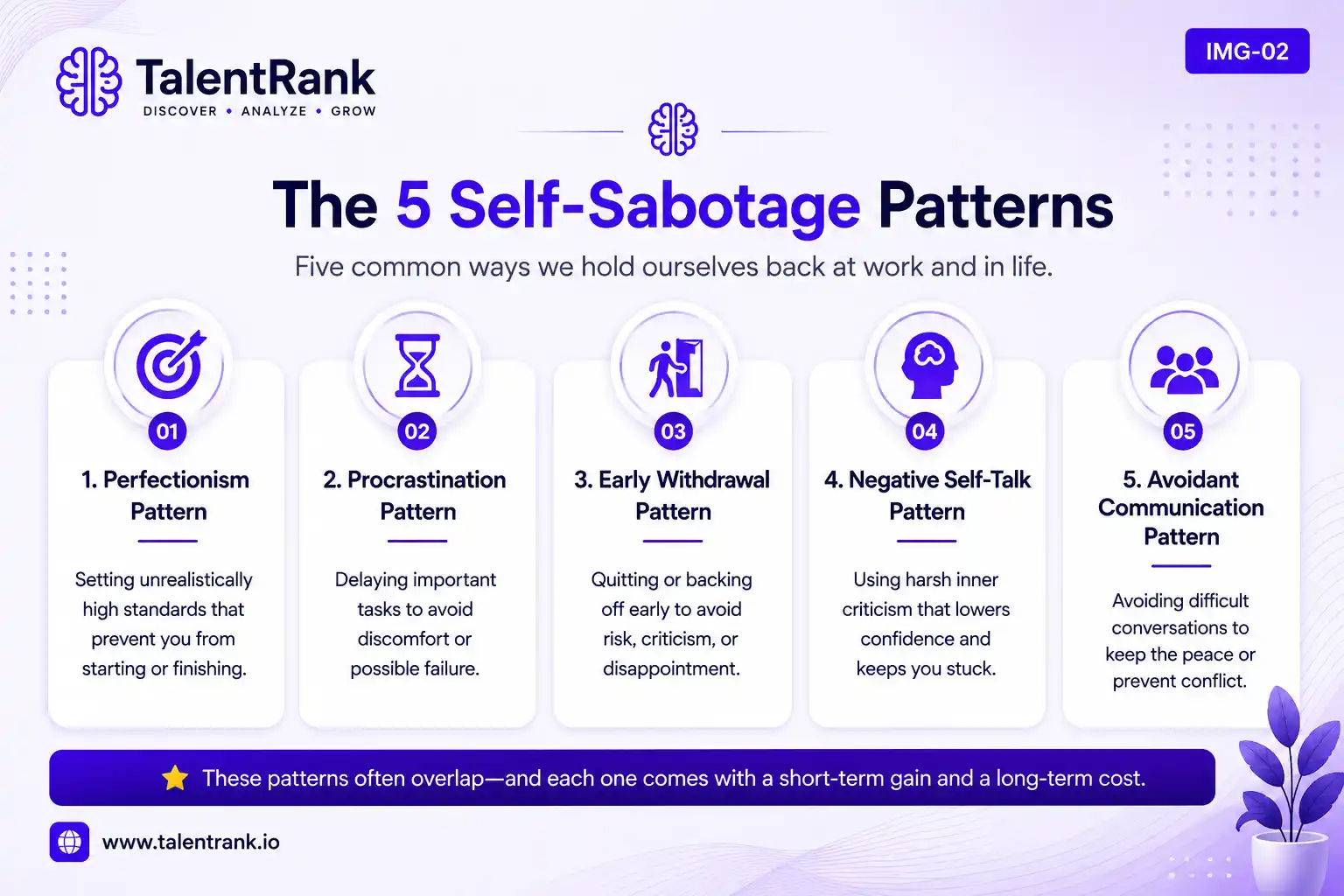
| Pattern | Common thought | Typical behavior | Immediate cost | First response |
|---|---|---|---|---|
| Perfectionism | “It is not ready.” | Endless checking | Delayed completion | Define “done” |
| Procrastination | “I will start later.” | Avoiding the task | Rising pressure | Start for five minutes |
| Quitting too soon | “This is not for me.” | Leaving after setbacks | Lost opportunity | Set a trial period |
| Negative self-talk | “I am not capable.” | Avoiding challenges | Reduced confidence | Check the evidence |
| Avoidant communication | “It is easier to stay quiet.” | Withholding concerns | Unresolved problems | State one clear need |
1. The Perfectionism Pattern
The perfectionism pattern appears when your standard for acceptable work becomes so demanding that it prevents progress or completion. You may keep checking, rewriting, researching, or preparing because submitting the work would expose it to judgment. High standards can support good performance, but impossible standards can keep useful work unfinished.
It may sound like:
- “I need more time before anyone sees this.”
- “One mistake will ruin the whole thing.”
- “I cannot submit work unless it is flawless.”
- “Other people will notice everything I missed.”
At work, this behavior may appear as spending hours on a low-impact detail, refusing to delegate, delaying a presentation, or avoiding a new role until you meet every listed requirement.
The problem is not caring about quality. The problem begins when quality has no clear finish line.
Research treats perfectionism as a multi-part concept. High standards are not automatically harmful. Greater difficulty may appear when fear of mistakes, fear of judgment, or the belief that approval depends on flawless work prevents someone from starting, finishing, or learning.
Try this first: Define “done” before you begin.
Write down the minimum requirements that make the task accurate, useful, and ready for review. Complete those requirements before making optional improvements.
For example:
“The report is ready when the figures are checked, the recommendation is clear, and the formatting is readable.”
This rule creates a finish line without lowering important professional, legal, or safety standards.
Personality reflection: A person with high conscientiousness may value detail, reliability, and careful work. A better question is not, “Does conscientiousness cause perfectionism?” Ask, “Do my standards sometimes delay completion?” A Big Five result cannot prove that someone is a perfectionist.
2. The Procrastination Pattern
The procrastination pattern appears when you delay a meaningful task even though you expect the delay to make the situation worse. The immediate goal is often not to avoid the task forever. It is to avoid the discomfort connected with starting, such as boredom, uncertainty, confusion, fear of failure, or expected criticism.
It may sound like:
- “I work better under pressure.”
- “I need to be in the right mood.”
- “I will start after I finish a few smaller tasks.”
- “There is still plenty of time.”
At work, procrastination may involve answering easy emails instead of preparing a proposal, delaying a difficult conversation, waiting until the last day to apply for a role, or researching far beyond what the task requires.
The pattern often follows this cycle:
- The task creates discomfort.
- Avoiding it provides temporary relief.
- The deadline becomes more threatening.
- Pressure and self-criticism increase.
- Starting feels even harder.
Try this first: Reduce the task to a five-minute starting action.
Replace “finish the presentation” with “open the file and write three rough headings.” Replace “apply for jobs” with “save one suitable role and draft the first sentence.”
You can also use an if-then plan:
“If it is 9:00 a.m., then I will open the proposal and work on it for five minutes.”
Research on implementation intentions suggests that clear if-then plans can improve the chance of acting on an intention. They do not guarantee success, but they make the next action more specific.
Personality reflection: Instead of assuming that a lower conscientiousness score explains procrastination, ask, “Do I need more structure, clearer deadlines, or a smaller starting step?” Workload, health, task clarity, skills, environment, and emotions also affect follow-through.
3. The Quit-Too-Soon Pattern
The quit-too-soon pattern appears when early discomfort or slow progress is treated as proof that a goal is wrong, impossible, or unsuitable. Leaving a harmful or clearly unproductive situation can be wise. The concern is a repeated habit of abandoning useful goals before you have enough evidence to judge them fairly.
It may sound like:
- “I should already be better at this.”
- “This setback proves it will not work.”
- “Successful people would find this easier.”
- “I have probably chosen the wrong path.”
At work, this behavior may appear as leaving a new role during the normal learning period, abandoning a useful course after one difficult module, changing career plans whenever confidence falls, or stopping a project when early feedback is mixed.
Quitting can provide immediate relief because you no longer have to face uncertainty, beginner-level performance, or possible public failure. The longer-term cost is that you may never stay with a goal long enough to build skill.
Because quitting can look like sensible reevaluation, this pattern is easy to overlook.
Try this first: Set a fair trial period before deciding.
- Complete four lessons before judging a course.
- Follow a new work system for three weeks before replacing it.
- Attend six relevant networking events before deciding they do not help.
- Submit ten suitable applications before concluding that your approach has failed.
At the review point, examine evidence rather than mood. Ask what improved, what remained difficult, what support was missing, and whether the goal still fits your values.
A trial period is not a reason to remain in an unsafe, abusive, or damaging situation.
Personality reflection: Rather than saying, “My openness score makes me quit,” ask, “Do I leave when a new situation feels unfamiliar or uncertain?” A trait may support reflection, but it does not predict one fixed response.
4. The Negative Self-Talk Pattern
The negative self-talk pattern appears when an automatic judgment about yourself is treated as an objective fact. Instead of seeing one mistake as information about one task, you turn it into a conclusion about your intelligence, worth, talent, or future. That conclusion then shapes which opportunities you pursue or avoid.
It may sound like:
- “I always ruin important opportunities.”
- “I am not smart enough for this.”
- “Everyone else is more capable.”
- “One rejection proves I do not belong here.”
At work, this behavior may stop you from applying for a promotion, asking a question, sharing an idea, negotiating pay, or accepting a challenging assignment. You may reject yourself before another person has made a decision.
Negative self-talk can also distort feedback. A manager may say that one section needs stronger evidence, but you hear, “My entire performance is poor.”
Try this first: Separate the fact from the interpretation.
| Observable fact | Automatic interpretation | More accurate response |
|---|---|---|
| My proposal was not selected. | I have no valuable ideas. | This proposal was not selected. I can ask for feedback. |
| I made an error in the spreadsheet. | I am bad at my job. | I made one error. I can correct it and improve the check. |
| I did not receive a reply. | Nobody wants to hire me. | One employer did not reply. I can continue applying. |
The replacement statement should not be false praise. It should be specific, balanced, and based on the available evidence.
Personality reflection: Higher negative emotionality may mean that worry or disappointment feels more intense. A useful question is, “Do strong emotions make me treat one event as proof about my whole future?” A personality score does not establish self-sabotage.
5. The Avoidant Communication Pattern
The avoidant communication pattern appears when you withhold a concern, need, question, or boundary because speaking feels uncomfortable. Silence may reduce the immediate risk of disagreement or embarrassment, but it often leaves other people without the information they need to solve the problem.
It may sound like:
- “They should know what I need.”
- “Speaking up will make me look difficult.”
- “It is easier to handle it alone.”
- “I will wait and see whether the issue disappears.”
At work, this behavior may involve agreeing to an unrealistic deadline, not asking for clarification, hiding a mistake, avoiding feedback, staying silent about workload, or withdrawing from a colleague instead of discussing a concern.
Avoidance can create confusion. Your manager may assume that you understand the task. Your colleague may not know that their behavior caused a problem. Your team may believe that you support a decision because you did not express a concern.
Try this first: State one clear need without explaining everything.
Use this structure:
“When a specific situation happens, it affects the work in this way. I need this clear next step.”
For example:
“When the deadline changes without an updated priority list, I am not sure which task should move first. I need us to confirm the top two priorities.”
The goal is not to remove all discomfort. It is to communicate enough information for the next useful action.
Personality reflection: Introversion is not the same as avoidance. A person with high agreeableness or lower extraversion may prefer harmony, more time to think, or lower-stimulation settings. Ask, “Do I need preparation time before difficult conversations?” Do not treat a personality preference as a permanent communication limit.
Why Do People Self-Sabotage?
People may act against their goals because familiar behavior can feel safer than uncertainty, rejection, criticism, conflict, or possible failure. Low confidence, perfectionistic concerns, past experiences, and a strong need for control may also play a role. The cause differs from person to person, so one behavior should never be treated as a diagnosis.
A repeated pattern often provides an immediate benefit, even when the long-term result is harmful.
- Procrastination may reduce discomfort for an hour.
- Perfectionism may delay judgment.
- Negative self-talk may lower expectations before an uncertain result.
- Avoidant communication may prevent an uncomfortable conversation today.
- Quitting may remove the pressure of being a beginner.
This is why telling yourself to “be more disciplined” may not be enough. The behavior may be solving a short-term emotional problem.
Trigger-to-Cost Framework
Trigger → uncomfortable thought or feeling → protective behavior → short-term relief → long-term cost
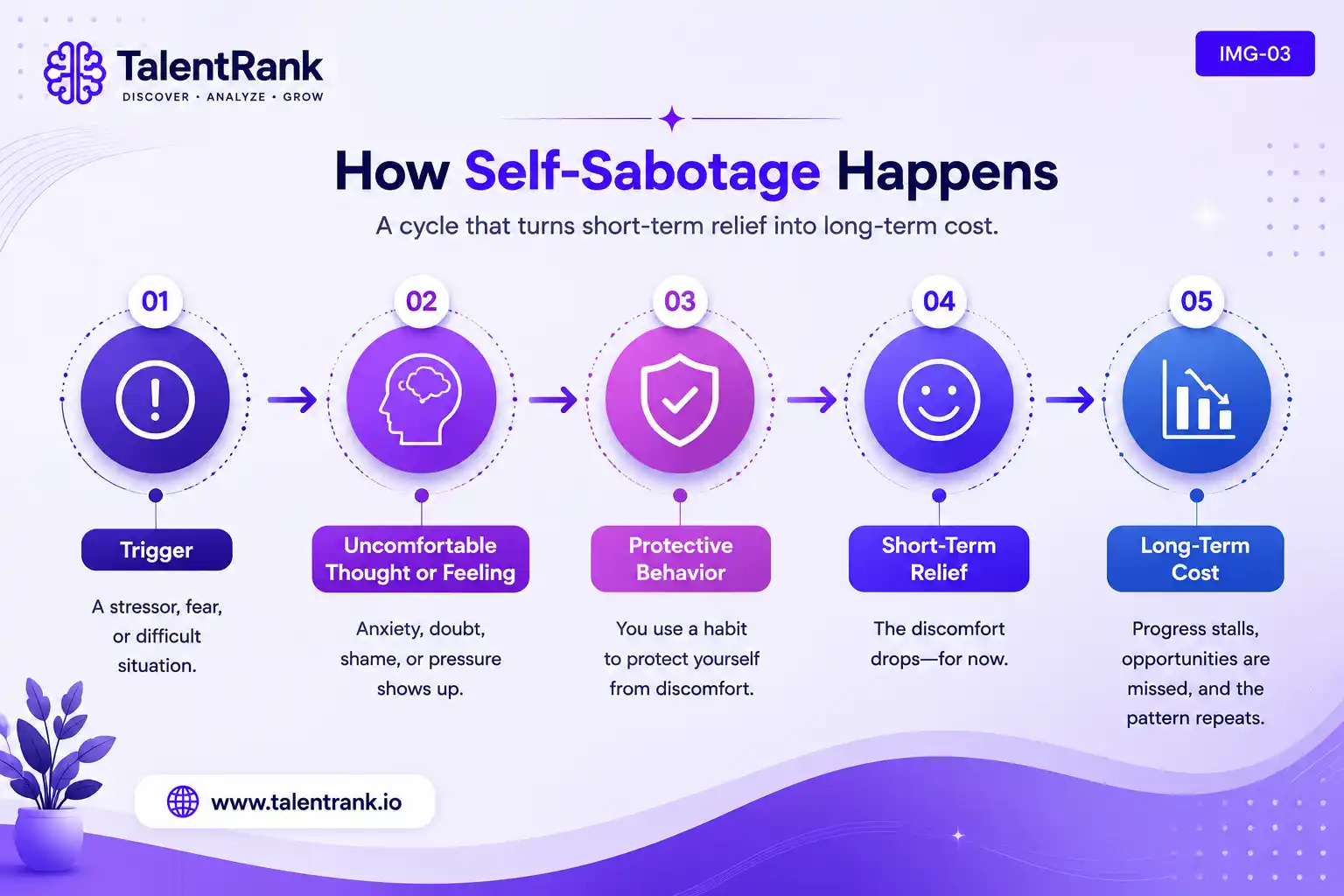
Example:
Job application → fear of rejection → endless editing → temporary safety → missed deadline
Once this sequence becomes visible, you can choose a different response at the point where the protective behavior normally begins.
Can Personality Traits Influence Self-Sabotage?
Personality traits may influence how a behavior appears, but they do not determine that someone will fail, delay action, or avoid progress. A trait can support strengths in one setting and create a challenge in another. Habits, skills, health, workload, culture, support, and current circumstances also affect what someone does.
The Big Five personality traits model describes personality across openness, conscientiousness, extraversion, agreeableness, and negative emotionality or emotional stability. These are broad dimensions, not good or bad personality types.
| Trait tendency | Question worth exploring | Important limitation |
|---|---|---|
| High conscientiousness | Do high standards sometimes delay completion? | The trait often supports reliability |
| Higher negative emotionality | Does worry affect decisions under pressure? | It does not prove self-sabotage |
| Lower extraversion | Do visible situations require more preparation? | Introversion is not avoidance |
| Lower openness | Do unfamiliar methods create early resistance? | Consistency can also be useful |
| High agreeableness | Do you avoid necessary disagreement? | The trait often supports cooperation |
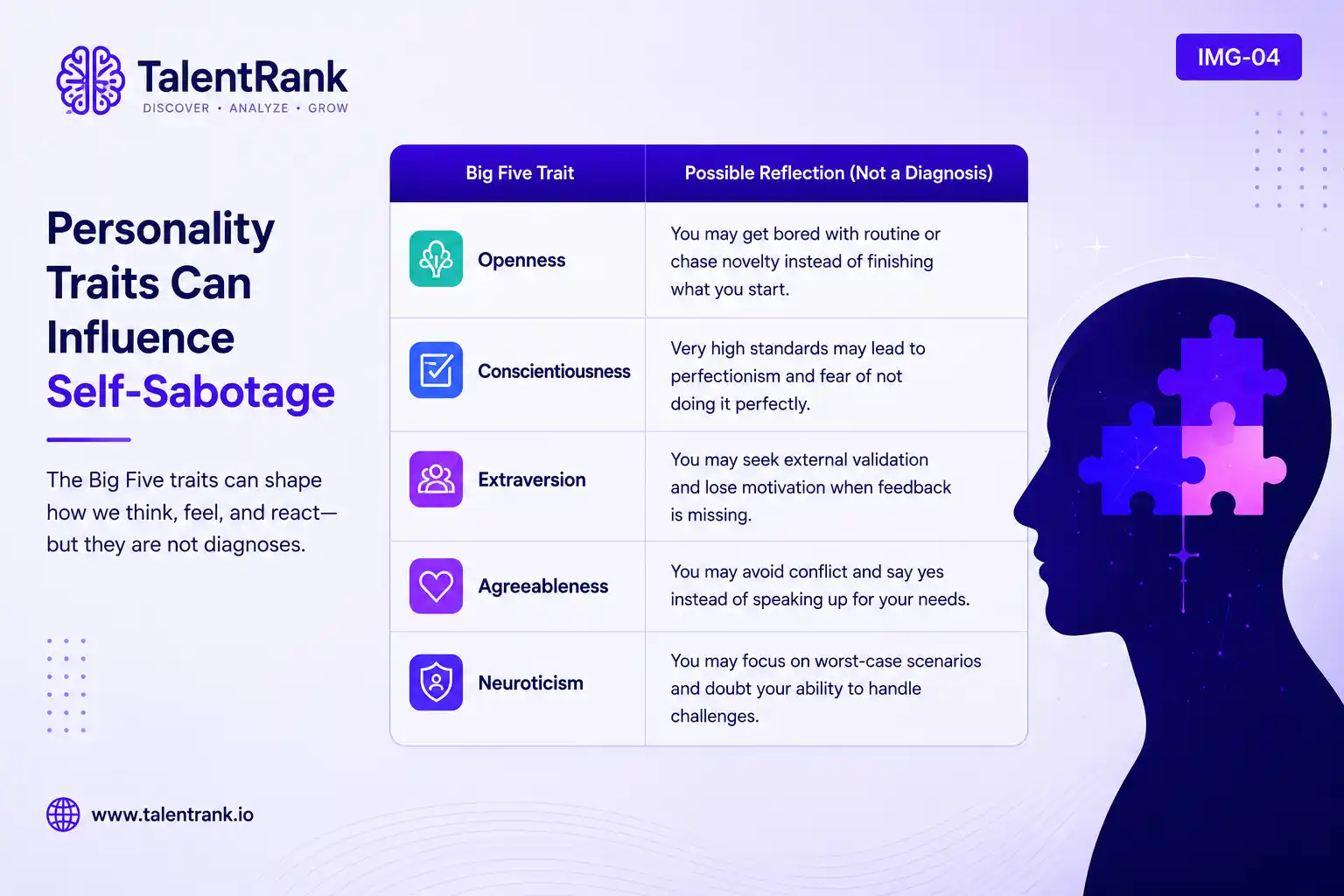
These questions are prompts for reflection, not predictions. A responsible personality test should help you form better questions rather than attach a permanent label.
A useful question is:
“Under pressure, how might this trait affect the way I respond?”
That is more helpful than saying:
“My personality makes me self-sabotage.”
Can an MBTI Test or IQ Test Identify Self-Sabotage?
Neither an MBTI assessment nor a cognitive ability test is designed to diagnose self-sabotage or explain why a person repeatedly acts against a goal. MBTI describes reported preferences, while IQ and cognitive tests measure selected mental abilities. They do not directly measure fear of judgment, emotional avoidance, perfectionism, or communication habits.
Official Myers-Briggs guidance describes MBTI results as preferences rather than measures of ability, skill, or character. It also warns against using personality type to decide whether someone is suitable for a job. For a closer look, see our comparison of Big Five vs MBTI.
Cognitive assessments may examine areas such as verbal reasoning, number or letter series, matrix reasoning, or spatial tasks. If you are unsure how these scores work, read our honest guide to what an IQ test measures.
A person can perform well on a cognitive test and still delay applications because rejection feels threatening. Another person can show strong verbal reasoning and still avoid conflict. Ability and behavior are not the same measurement, which is also clear when you look at high IQ and career performance.
| Assessment | What it may describe | What it cannot establish |
|---|---|---|
| Big Five personality test | Broad personality tendencies | A diagnosis or fixed behavior |
| MBTI assessment | Reported preferences | Ability, character, or future behavior |
| IQ or cognitive test | Selected reasoning abilities | Motivation or emotional coping |
| Career assessment | Interests, preferences, or possible fit | Guaranteed career success |
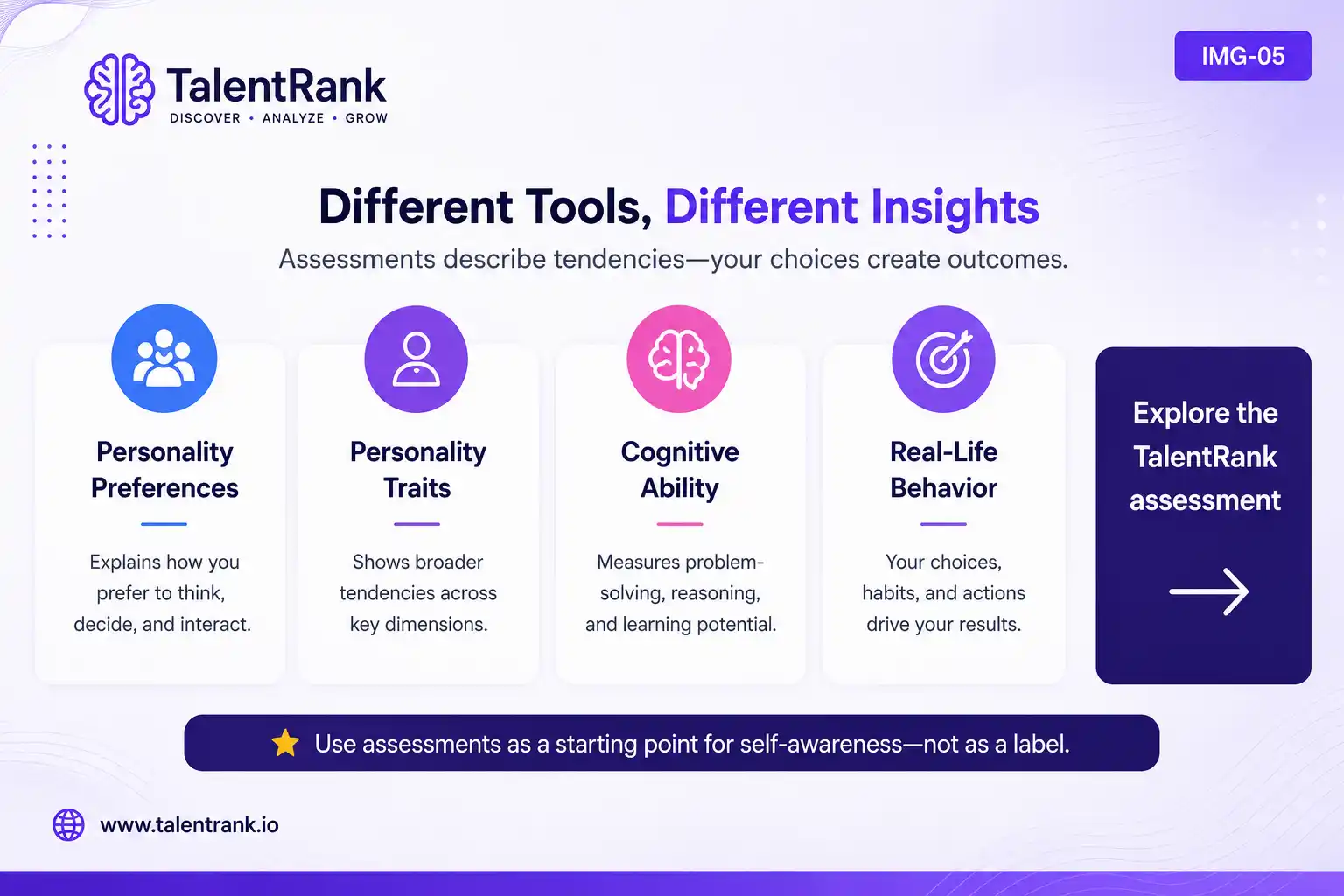
Combining personality and cognitive ability information can add useful context. Use any assessment result as one source of information. Compare it with repeated behavior, real outcomes, feedback, values, and experience. An assessment should support reflection rather than replace professional judgment or mental health care.

Use a personality assessment as a starting point for reflection, not as a diagnosis. Explore the TalentRank assessment.
How Do You Stop Self-Sabotaging?
To interrupt repeated self-defeating behavior, identify the action and the situation that triggers it. Then replace it with one small, specific response. Define a “good enough” standard, begin for five minutes, set a fair trial period, test negative thoughts against evidence, or state one clear need instead of withdrawing.
Use this five-step process:
- Name the behavior. Describe what you do without attacking your character.
- Find the trigger. Notice the task, thought, feeling, or situation that comes first.
- Identify the short-term benefit. Ask what the behavior helps you avoid.
- Choose a replacement action. Make it small enough to complete.
- Review the result. Look for evidence of progress rather than perfection.
Example:
- Behavior: I delay sending applications.
- Trigger: I compare my experience with every requirement.
- Short-term benefit: I avoid possible rejection.
- Replacement action: I submit one application when I meet the main requirements.
- Review: I record what happened and improve the next application.
Progress often begins with a smaller change than people expect. You do not need to remove every doubtful thought before acting. You need a response that helps you take the next useful step despite the thought.
How to Stop Self-Sabotaging at Work
Workplace self-sabotage is best addressed through observable behavior rather than personality labels. Identify the exact action creating the problem, understand the situation that triggers it, and choose a realistic replacement. This approach is more useful than telling yourself or an employee to become more confident, motivated, organized, or outgoing.
You may be blocking your progress at work when you repeatedly:
- Delay sending completed work
- Avoid applying unless you meet every requirement
- Stay silent when instructions are unclear
- Treat one correction as proof of failure
- Leave new responsibilities before the normal learning period ends
- Reject useful feedback without examining it

Use these pattern-specific responses:
- Perfectionism: Send a draft at the agreed review stage instead of polishing it alone.
- Procrastination: Schedule the first 15 minutes of a difficult task before opening email.
- Quitting too soon: Agree on a review date before abandoning a new process.
- Negative self-talk: Request specific feedback instead of assuming one result defines your ability.
- Avoidant communication: Raise one concern while there is still time to solve it.
Managers should discuss observable behavior and its impact.
Useful wording:
“The report arrived two days late, which delayed the client review.”
Unhelpful wording:
“Your personality type means you cannot manage deadlines.”
Personality and cognitive assessments can support development conversations, but they should not replace job evidence, direct communication, fair support, or a proper performance process.
When to Seek Professional Help
Consider professional support when distressing thoughts or behaviors persist, interfere with work or daily activities, damage important relationships, or feel difficult to change on your own. A qualified mental health professional can explore causes that a personality test, IQ test, or general self-help article cannot assess.
The National Institute of Mental Health advises people to consider professional help when severe or distressing symptoms last for two weeks or more. These may include problems with sleep, concentration, mood, interest, or the ability to complete usual tasks.
Seek urgent local help when you or someone else may be in immediate danger or is experiencing a mental health crisis.
- United States: Call or text 988. Call 911 in a life-threatening emergency.
- Canada: Call or text 9-8-8. Call 9-1-1 if safety is at immediate risk.
- Australia: Call Lifeline on 13 11 14. Call 000 in an immediate emergency.
- United Kingdom: Follow NHS urgent mental health guidance or contact emergency services when immediate help is needed.
This article is educational. It does not diagnose a condition or replace medical, psychological, or emergency support.
Frequently Asked Questions
What is the most common form of self-sabotage?
There is no single form that applies to everyone. Procrastination is one of the most widely studied self-defeating work behaviors, but perfectionism, early withdrawal, negative self-talk, and avoidant communication may be more important for another person. Focus on the response that repeatedly blocks a goal you value.
Is procrastination always self-sabotage?
No. Delaying a task may be reasonable when priorities change, information is missing, rest is needed, or another deadline is more important. It becomes more likely to be self-sabotaging when the delay repeats, provides short-term emotional relief, and predictably harms a goal you genuinely want to achieve.
Can perfectionism be a form of self-sabotage?
Yes. Perfectionism can become self-sabotaging when rigid standards prevent starting, finishing, delegating, learning, or submitting work. Caring about quality is not the problem. The warning sign is that no realistic level of work feels complete enough to share or evaluate.
Can personality tests reveal self-sabotage?
A personality test can highlight tendencies that support useful reflection, such as how you approach structure, uncertainty, social interaction, or stress. It cannot diagnose self-sabotage or prove why you behave in a certain way. Compare assessment results with repeated actions, context, feedback, and real outcomes.
Does a high IQ prevent self-sabotage?
No. Cognitive ability and self-sabotaging behavior are different concepts. A person may reason well and still avoid a task because of fear, perfectionism, conflict, or low confidence. An IQ or cognitive test may describe selected abilities, but it does not establish motivation, emotional coping, or communication habits.
Is self-sabotage a mental health diagnosis?
No. Self-sabotage is a general term used to describe behavior that works against a person’s goals. It is not a diagnosis by itself. Similar behaviors may appear for many reasons, so persistent distress or serious disruption should be discussed with a qualified mental health professional.
Can self-sabotage be stopped completely?
Patterns can change, but progress may not mean that every doubtful thought disappears. A realistic goal is to notice the trigger earlier and choose a more useful response more often. Persistent or distressing behavior may benefit from support from a qualified mental health professional.
The Bottom Line
The most useful way to understand self-sabotage is to see it as a repeated response rather than a personal defect. Perfectionism, procrastination, quitting too soon, negative self-talk, and avoidant communication may protect you from discomfort for a moment while limiting progress over time. A Big Five, MBTI, personality, or IQ test can support reflection, but it cannot diagnose the cause or decide your future. Notice the behavior, identify the trigger, and choose one small replacement action that moves you closer to the result you genuinely want.
Sources and Further Reading
- American Psychological Association: Research and expert discussion on procrastination, self-regulation, and emotion management.
- American Psychological Association: Guidance on healthy and unhealthy forms of perfectionism.
- Gollwitzer and Sheeran: Research review on implementation intentions and if-then planning.
- Colby College Personality Lab: Big Five Inventory-2 model and trait structure.
- The Myers-Briggs Company and Myers-Briggs Foundation: Official guidance on MBTI preferences, limitations, and workplace use.
- International Cognitive Ability Resource: Information about cognitive ability item types and assessment research.
- National Institute of Mental Health: Guidance on when to seek professional mental health support.
- Official crisis resources from 988 Lifeline, Canada 9-8-8, Healthdirect Australia, and the NHS.