


A numerical reasoning test can look simple until a table puts four different quantities in front of you. Sales, orders, costs, and percentages may all appear together. The difficult part is choosing the right numbers and relationship quickly enough to answer the question you were actually asked.
Work through the ten original exercises below before checking the answers. They use fictional business data, and every value you need is supplied. Start untimed, write down your calculation, and keep track of whether each mistake came from reading the table, choosing a formula, or doing the arithmetic.
What does a numerical reasoning test measure?
It assesses how you interpret quantities and use them to reach a conclusion. Questions can involve tables, charts, fractions, ratios, rates, or percentage changes. The exact content and interface depend on the provider and assessment version.
SHL's Numerical Ability fact sheet describes interpreting numerical data and applying mathematical methods. Its separate interactive numerical assessment uses workplace scenarios. Check the name on your invitation before borrowing timing or navigation advice from another format.
How to approach a numerical reasoning test question
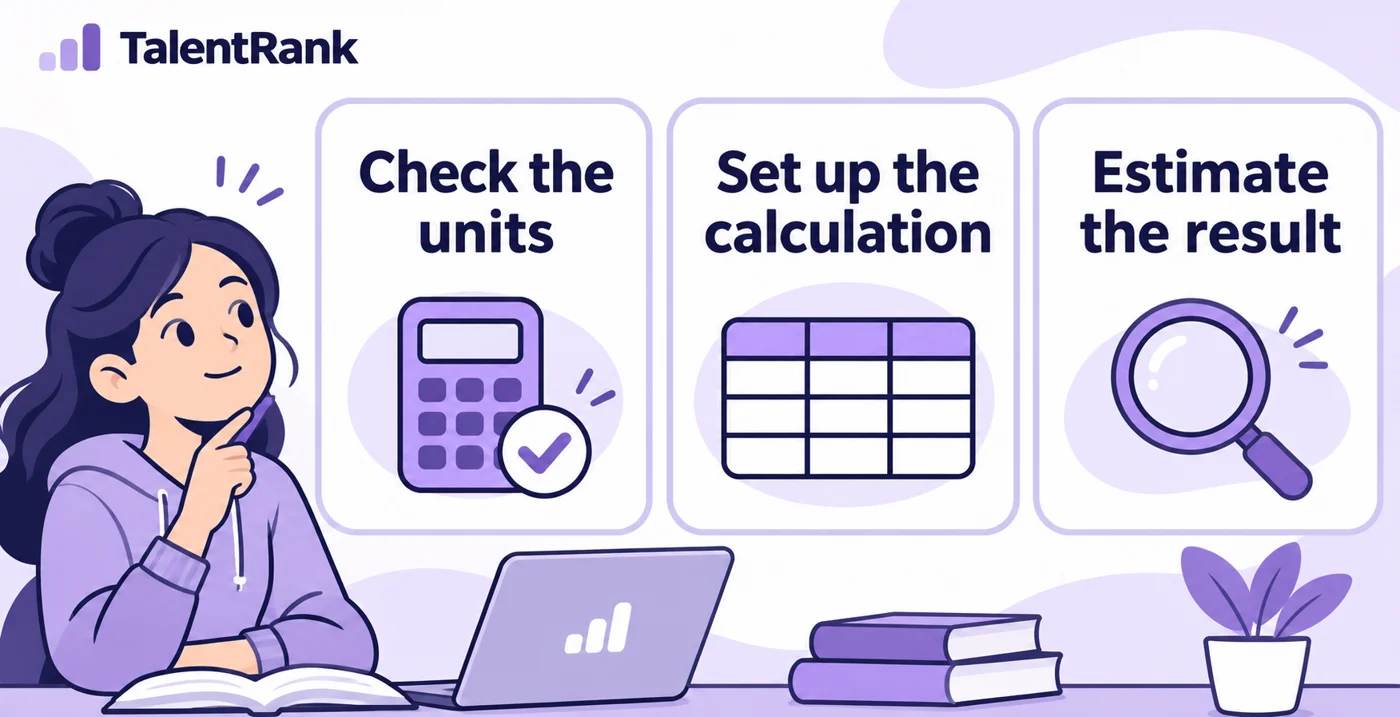
Read the question first and underline the quantity it requests. Then find the matching rows, columns, period, and units. Before opening a calculator, write a short expression. That expression should tell you which number is the starting value, which is the total, or which is the number of units.
For percentage change, divide the change by the starting value. For a share of a total, divide the part by the whole. For an average price, divide total revenue by the number of orders. These calculations can use the same numbers in different positions, which is why selecting the relationship matters.
Numerical reasoning practice test: sales data
The table shows a fictional retailer's results. Revenue figures are thousands of dollars. Order counts are individual orders. All calculations use the figures shown, with no tax, returns, or other adjustments.
Region | Revenue 2024 ($000) | Revenue 2025 ($000) | Orders 2025 |
North | 240 | 300 | 1,200 |
South | 180 | 216 | 900 |
West | 160 | 200 | 800 |
1. Percentage growth
By what percentage did North's revenue rise from 2024 to 2025? A. 20%. B. 25%. C. 60%.
2. Share of revenue
What percentage of the company's 2025 revenue came from South? Round to one decimal place. A. 30.2%. B. 33.3%. C. 35.1%.
3. Revenue per order
What was West's average revenue per order in 2025? A. $25. B. $250. C. $2,500.
4. Combining regions
What was the ratio of North's to West's 2025 revenue, in its simplest form? A. 2:3. B. 3:2. C. 3:5.
5. A weighted average
What was the company's average revenue per order across all three regions in 2025? Round to the nearest cent. A. $246.67. B. $246.90. C. $265.19.
Numerical reasoning test practice: costs and staffing
This second fictional business sells a single service package. The figures cover one month. Treat the variable cost as applying to every package sold and the fixed cost as a single monthly amount.
Item | Value |
Selling price per package | $80 |
Variable cost per package | $50 |
Monthly fixed costs | $12,000 |
Packages sold | 600 |
Employees | 8 |
Hours worked per employee | 150 |
6. Profit
What was the month's profit, using only the costs shown? A. $6,000. B. $18,000. C. $30,000.
7. Break-even volume
How many packages must the business sell to cover both its variable and fixed costs? A. 150. B. 240. C. 400.
8. Percentage points
A separate report says the business's repeat-customer share rose from 30% to 36%. Which statement is correct? A. It rose by 6 percentage points and by 20% relative to its starting share. B. It rose by 6% relative to its starting share. C. It rose by 20 percentage points.
9. Reverse percentage
A discounted package now costs $68 after a 15% price reduction. What was its original price? A. $78.20. B. $80. C. $83.
10. A rate
Using the staffing table, how many packages were sold per total employee-hour? A. 0.5. B. 4. C. 75.
Numerical reasoning test answers and explanations
1. B, 25%. Revenue increased by 300 − 240 = 60 thousand dollars. Divide 60 by the starting revenue of 240 and multiply by 100. Using the final value as the denominator gives 20%, which answers a different comparison.
2. A, 30.2%. Total 2025 revenue was 300 + 216 + 200 = 716 thousand dollars. South's share is 216 ÷ 716 × 100 = approximately 30.17%. Round once at the end. The three regions have different revenues, so dividing 100% equally between them does not work.
3. B, $250. The table records revenue in thousands. West earned $200,000 from 800 orders. Dividing gives $250 per order. If your result seems unusually small or large, check the column's unit before repeating the calculation.
4. B, 3:2. North and West earned 300 and 200 thousand dollars. Divide both numbers by 100. Keep the order in the question: North comes first. The ratio 3:5 would describe North's share of the two-region total, rather than North compared with West.
5. B, $246.90. Add the revenues and order counts separately: $716,000 and 2,900 orders. Divide the totals to get approximately $246.8966. Averaging the regional averages gives approximately $246.67, but treats each region as having the same number of orders.
6. A, $6,000. Revenue is 600 × $80 = $48,000. Variable costs are 600 × $50 = $30,000. Subtract both variable and fixed costs: $48,000 − $30,000 − $12,000 = $6,000. The $18,000 option is the amount left before fixed costs.
7. C, 400. Each sale contributes $80 − $50 = $30 toward fixed costs. Divide $12,000 by $30. At 400 packages, revenue is $32,000 and total costs are $20,000 + $12,000, so the figures balance.
8. A. The difference is 36% − 30% = 6 percentage points. Relative to the original share, the increase is 6 ÷ 30 × 100 = 20%. Write both quantities out if a question mixes percentages and percentage points.
9. B, $80. After the discount, the price is 85% of its original value. Divide $68 by 0.85. Adding 15% of the reduced price produces $78.20, which uses the wrong base. Check by applying the discount to $80: 15% is $12, leaving $68.
10. A, 0.5. Total employee-hours are 8 × 150 = 1,200. Divide 600 packages by 1,200 hours. The result is one package per two employee-hours. Dividing by eight alone gives packages per employee, while dividing by 150 uses only one employee's hours.
Use your mistakes to choose the next drill
After a numerical reasoning test practice session, sort mistakes into three groups. A reading error means you selected the wrong year, row, or unit. A setup error means you chose the wrong denominator or relationship. An arithmetic error means the setup was right but the calculation went wrong.
For reading errors, practise writing the unit beside each selected number. For setup errors, explain the operation in words before calculating. For arithmetic errors, estimate the answer first and check whether the exact result has the right order of magnitude. A fresh question is more informative than repeating an answer you remember.
Practise the denominator
Percentage questions often turn on which value belongs underneath the fraction. In a numerical reasoning test, the words “increase from,” “share of,” and “discounted by” each point to a different relationship. Write that relationship before inserting values.
Keep rounding until the end
Carry the calculator's precision through intermediate steps when possible. Round only to the accuracy requested by the question. If answer options are close, early rounding can change which option appears correct.
Before taking a numerical reasoning test
Check your invitation for the version, time limit, allowed tools, and whether you may revisit answers. Practice at that pace after you can solve unfamiliar items accurately without timing. A provider's official sample can help you get familiar with its interface.
The published SHL fact sheets above describe different formats, so their question counts and time limits should be attached to the named versions. Use the current instructions in your invitation when they differ from a general preparation guide.
Frequently asked questions
Does a numerical reasoning test require advanced mathematics?
The examples here use basic arithmetic and relationships. The challenge is reading data accurately and choosing an operation. Your actual assessment may cover a different range, so check its official sample and topic guidance.
Can I use a calculator?
Follow the rules for your assessment. During learning, a calculator lets you focus on setting up a problem. An estimate still helps you catch a missing zero or a result that uses the wrong unit.
What score should I aim for?
Use these ten original questions to identify revision needs. They have no norm group or validated passing score. Employer requirements and the assessment's scoring method determine how an actual result is used.
What should I practise after this numerical reasoning test?
Change one value in a question you missed and solve it again. If you want another kind of reasoning practice, try TalentRank's mechanical aptitude questions, which focus on physical systems and forces.
Make the next session specific
Choose one repeated error, such as percentage bases or units, and spend the next session on fresh examples of that type. Then return to a mixed set. That sequence helps you see whether your method works when the question format changes and the answer is unfamiliar.