

A mechanical aptitude test asks you to predict what happens when parts interact. Which gear turns faster? Which side of a beam drops? How much rope must you pull to raise a load? The useful clue is usually something you can mark on the diagram: a contact point, a pivot, a supporting strand, or the direction of a force.
Try these 12 original questions before opening the answer key. The early items isolate one principle. The later items ask you to track two quantities at once. When you check your answers, pay attention to which detail you missed. That tells you what to practise next.
What does a mechanical aptitude test measure?
It measures how you reason about physical systems. Topics vary by provider. SHL lists leverage, weight and balance, gears, pulleys, hydraulics, temperature, and pressure for its Mechanical Comprehension assessment. Criteria offers a shortened mechanical reasoning simulation for candidates. Use your invitation to identify the provider and check the actual test rules.
How to use this mechanical aptitude practice test
Take the first pass without a timer. Write down your answer and the clue that determined it. If you guessed correctly, mark the question for review anyway. On a mechanical aptitude test, two options can look reasonable until you identify exactly what is being asked: direction, speed, force, or distance.
Questions 1–4: Gears, levers, and balance
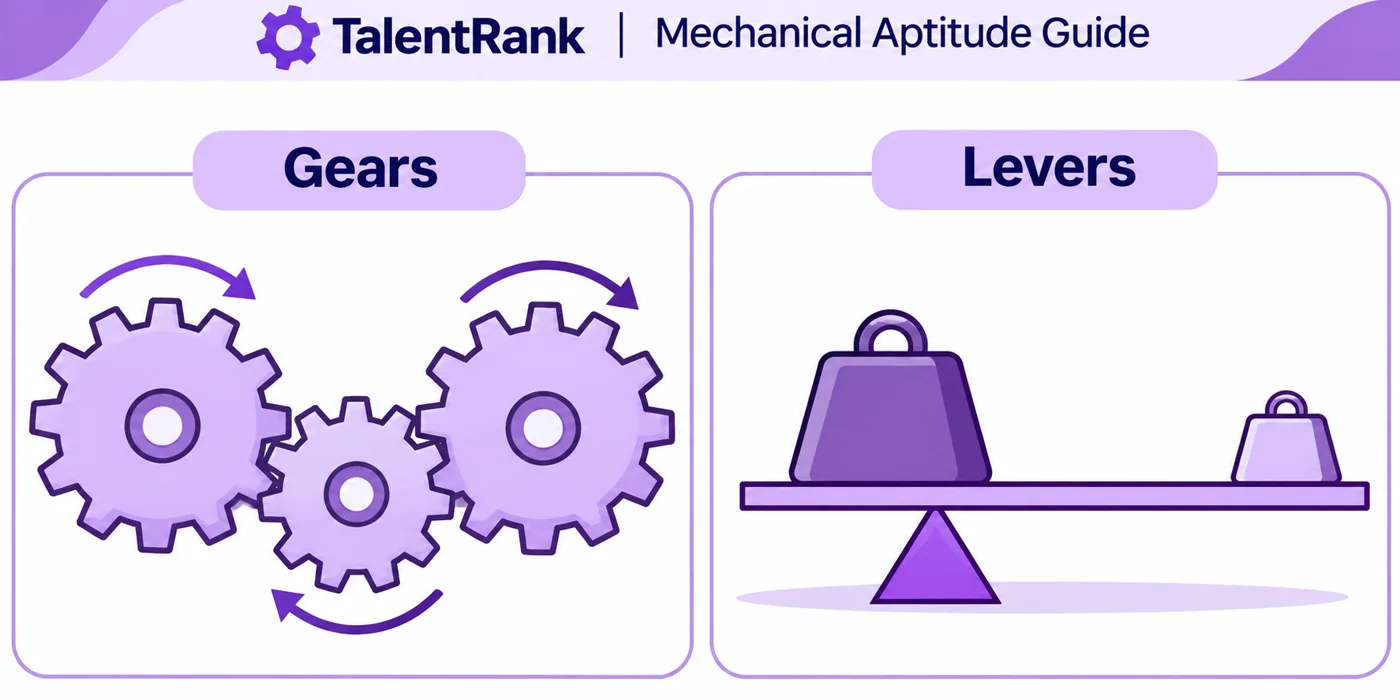
1. Gear direction. Three external gears sit in a row, A–B–C. A turns clockwise. How does C turn? A. Clockwise. B. Counterclockwise. C. It depends on the size of B.
2. Gear speed. An 18-tooth gear drives a 54-tooth gear. The smaller gear makes six full turns. How many turns does the larger gear make? A. Two. B. Six. C. Eighteen.
3. Lever balance. A 90 N load hangs 20 cm to the left of a pivot. A second load hangs 60 cm to the right. What weight balances the lever? Ignore the lever's own weight. A. 30 N. B. 90 N. C. 270 N.
4. Wrench grip. You pull perpendicular to a wrench handle. You move your hand from 15 cm to 30 cm from the bolt and want the same turning effect. How much force do you now need? A. Half. B. The same. C. Twice as much.
Questions 5–8: Pulleys, friction, and pressure
5. Fixed pulley. A single ideal pulley hangs from a ceiling. A rope passes over it, with a 120 N load on one end and your hand on the other. What force lifts the load at constant speed? A. 60 N. B. 120 N. C. 240 N.
6. Moving pulley. Two vertical rope strands directly support an ideal moving pulley and its load. Their combined weight is 180 N. How hard do you pull, and how much rope do you pull to raise the assembly by 30 cm? A. 90 N and 60 cm. B. 90 N and 30 cm. C. 180 N and 60 cm.
7. Friction. Two identical boxes start from rest and slide down ramps with the same length and slope. The first ramp offers less sliding friction. Which box reaches the bottom first? A. The first. B. The second. C. They arrive together.
8. Contact pressure. A rectangular block weighs 120 N. One face is 20 square centimeters and another is 60. When you turn it from the smaller face onto the larger face, what happens to the average pressure? A. It triples. B. It stays the same. C. It falls to one-third.
Questions 9–12: Combining clues
9. Hydraulics. An ideal hydraulic system has pistons with areas of 4 and 20 square centimeters. A 28 N push acts on the smaller piston. At the same height, what force does the larger piston exert? A. 5.6 N. B. 28 N. C. 140 N.
10. Compound gears. A 12-tooth gear turns clockwise and drives a 36-tooth gear. The 36-tooth gear shares a rigid shaft with a 15-tooth gear. That gear drives a 30-tooth gear. For six turns of the first gear, what does the final gear do? A. One clockwise turn. B. One counterclockwise turn. C. Two clockwise turns.
11. Tipping. Two crates have identical bases and equal weight. Their centers of mass are directly above the centers of their bases, one higher than the other. Both rest on the same slowly tilting platform. Assume neither can slide. Which crate tips at a smaller angle? A. The crate with the higher center of mass. B. The crate with the lower center of mass. C. Both tip at the same angle.
12. Heat and clearance. A metal plate has a round hole. The plate is heated evenly and can expand freely. What happens to the hole diameter? A. It increases. B. It decreases. C. It stays the same.
Mechanical aptitude test answers and explanations
1. A — Clockwise. Mark an arrow at each gear contact. A reverses B, and B reverses C. Two reversals bring you back to clockwise. Gear size affects speed, so it looks relevant even though the question asks only for direction.
2. A — Two turns. Six turns transfer 6 × 18 = 108 teeth past the mesh. Divide 108 by 54 teeth per turn. Eighteen is the result you get if you reverse the ratio and treat the driven gear as though it were the smaller gear.
3. A — 30 N. Calculate the turning effect around the pivot: 90 × 20 = 1,800 N·cm. The right side has three times the distance, so it needs one-third of the force. Divide 1,800 by 60. Equal weights would work only at equal distances.
4. A — Half. The perpendicular pull doubles its distance from the bolt, so a force half as large gives the same turning effect. Notice that the question specifies the pull direction. An angled pull would change the effective lever arm.
5. B — 120 N. This pulley redirects the pull. Follow the rope from the load: only one strand directly supports it. Seeing two sides of rope around the wheel can make 60 N look plausible. One side goes to your hand and does not attach to the moving load.
6. A — 90 N and 60 cm. Two strands share the 180 N weight, so each carries 90 N. Raising the pulley by 30 cm shortens both supporting spans by 30 cm. Pulling 60 cm of rope makes up that change. The lower force comes with a longer pull.
7. A — The first box. The slope provides the same downhill component of weight in both cases. Sliding friction opposes motion. Less friction leaves a greater net downhill force, so the first box accelerates faster from rest.
8. C — One-third. Pressure is force divided by area. The force remains 120 N, while the contact area triples. Comparing the two numbers makes the direction clear: 120 ÷ 20 = 6 N/cm², while 120 ÷ 60 = 2 N/cm².
9. C — 140 N. The small piston creates 28 ÷ 4 = 7 N/cm² of pressure. The same pressure acts across 20 square centimeters at the larger piston, giving 7 × 20 = 140 N. The pressure is shared. The force depends on the piston area.
10. A — One clockwise turn. The first mesh divides the turn count by three, giving the 36-tooth gear two counterclockwise turns. The 15-tooth gear shares its shaft, so it also makes two counterclockwise turns. The last mesh halves the turn count and reverses direction again. A shared shaft is the clue that separates rotation at a mesh from rotation together.
11. A — The higher center of mass. Imagine a vertical line drawn down from each center of mass. As the floor tilts, the line moves toward the downhill edge of the base. For a higher center of mass, it reaches that edge at a smaller tilt, assuming the centers were initially over the middle of their identical bases.
12. A — It increases. Imagine the hole filled by a circle of the same metal. With uniform heating, that imaginary circle would expand along with the plate. The opening expands the same way when the circle is absent. The tempting mistake is to picture the outside edge expanding while material moves inward at the hole.
What to practise after you score yourself

Score this mechanical aptitude test practice set out of 12, then make a note beside every missed or guessed item. Write “rule” if you did not know what principle applied, “setup” if you read the diagram incorrectly, or “calculation” if your method was right but the numbers went wrong. Two readers with the same score may need very different practice.
On your next mechanical aptitude test practice session, start with the error that repeated. Someone who can count gear reversals but keeps reversing the speed ratio needs a different drill from someone who loses track of rotation direction.
Direction errors, questions 1 and 10. Mark every external gear mesh with a reversal and every shared shaft with an equals sign. Check direction before calculating speed.
Leverage errors, questions 3 and 4. Circle the pivot and write the distance next to each force. Try again with the load twice as far from the pivot and predict what happens before calculating.
Pulley errors, questions 5 and 6. Sketch the moving load first. Trace only the rope strands attached to it or directly supporting its moving pulley. Then track how each strand changes length when the load rises.
Pressure errors, questions 8 and 9. Write force ÷ area once. Identify which quantity stays constant before comparing the setups.
Motion and geometry errors, questions 7, 11, and 12. Sketch the direction of motion, the edge that acts as a tipping point, or the part that expands. Ask what would change if the diagram were flipped.
Before taking a mechanical aptitude test
Check the invitation for the provider, number of questions, time limit, permitted tools, and rules for revisiting questions. Use the provider's official sample when available. A generic mechanical aptitude test practice set helps you review principles, while the official sample helps you get used to the provider's interface and instructions.
Once you can explain your untimed answers, try a fresh set at the pace your invitation calls for. At the end, record which mistakes came from the concept, which came from arithmetic, and which came from missing a word such as “faster” or “less.” That record gives you a better plan for your next session than a score alone.
Frequently asked questions
Use these answers to plan for your mechanical aptitude test, then check the instructions for your specific assessment.
Is a mechanical aptitude test the same as an IQ test?
Mechanical reasoning is a narrower task. These questions focus on predicting what happens when physical parts and forces interact. A general cognitive assessment may include other abilities, such as verbal or numerical reasoning.
What score do I need to pass a mechanical aptitude test?
Check with the organization that invited you. SHL says it does not set passing scores for its tests. Treat the score from these 12 practice questions as feedback about the concepts you should revisit. SHL guidance on pass marks
Do I need a calculator?
Follow the instructions for your particular assessment. For this practice set, you can work through the numbers by hand. Writing the relationship first often makes the arithmetic obvious.
Your next practice session
Pick the first question you missed and change one detail. Add a gear, move the pivot, or double the piston area. Predict what changes before working out the answer. Once you can explain the result in your own words, try a fresh question that uses the same principle.