

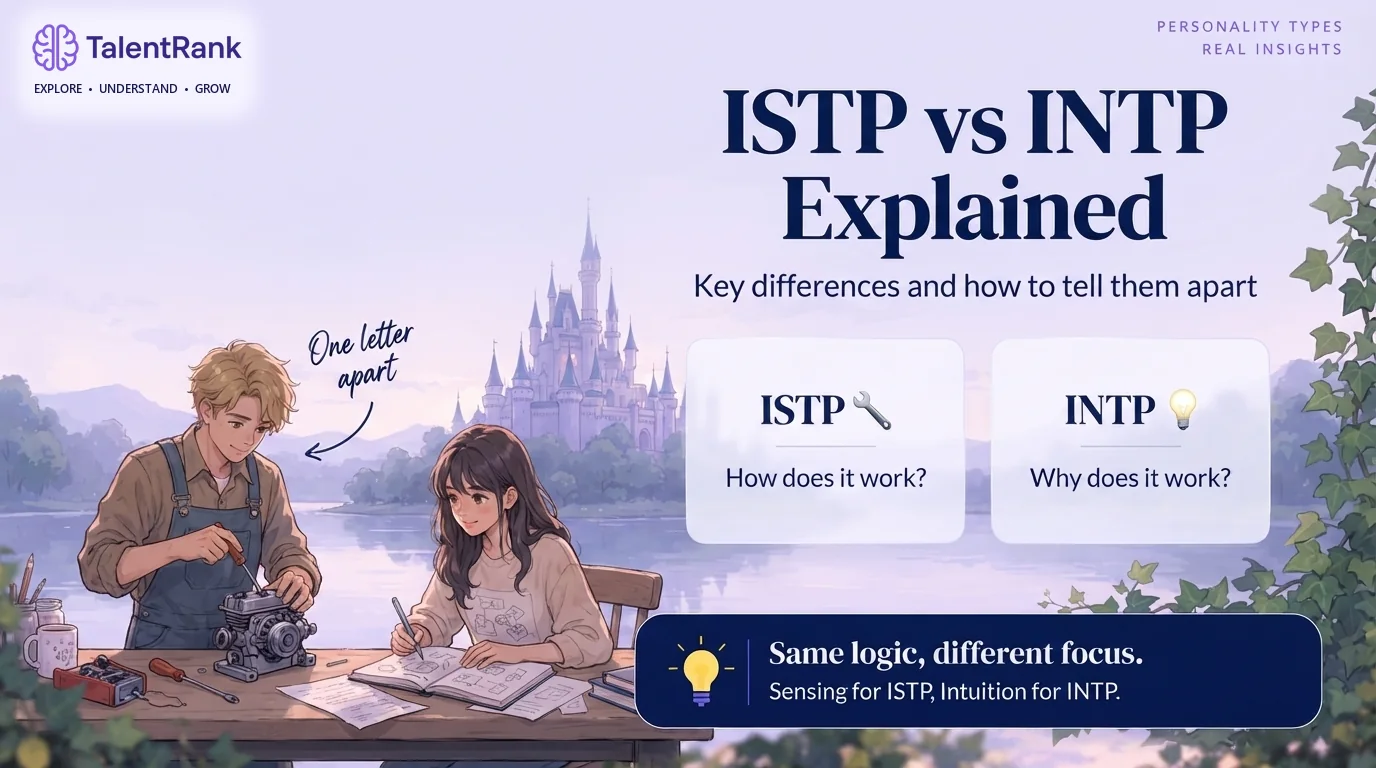
The core of ISTP vs INTP comes down to one letter. Both types are introverted, logical, independent, and flexible. The difference is the second letter: ISTPs prefer Sensing, so they focus on concrete facts and hands-on problems, while INTPs prefer Intuition, so they focus on patterns, theories, and possibilities. In short, an ISTP wants to know how something works so they can fix it; an INTP wants to know why it works so they can understand it.
That single difference shapes how each type learns, solves problems, relaxes, and works. This guide walks through the similarities, the real differences, and practical ways to tell which type fits you better.
What ISTP and INTP Have in Common
The Myers-Briggs Foundation describes ISTPs as "tolerant and flexible, quiet observers until a problem appears," and INTPs as seeking "to develop logical explanations for everything that interests them." (Myers-Briggs Foundation) Both descriptions point to the same foundation.
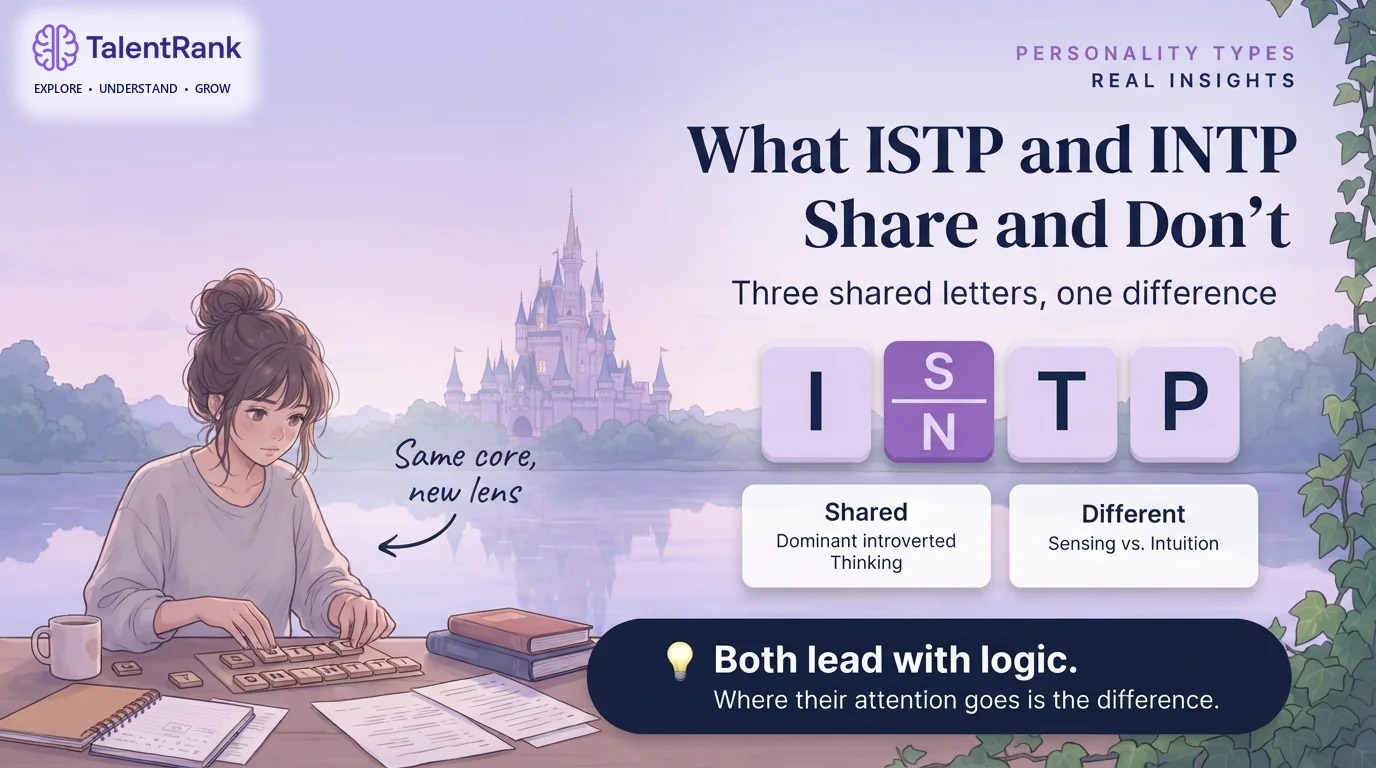
The two types share three of four letters:
Introversion: both recharge alone and think before they speak.
Thinking: both make decisions by logic and consistency.
Perceiving: both prefer flexibility and keeping options open.
They also share the same dominant mental process. According to the Myers-Briggs Foundation, both ISTP and INTP lead with introverted Thinking, an inner drive to make things logically consistent. (Myers-Briggs Foundation) That's why the two types can look almost identical at first: quiet, skeptical, analytical, and allergic to rules that don't make sense.
The Core Difference: Sensing vs. Intuition
Where they split is the auxiliary process, the one that balances the dominant one. The Myers-Briggs Foundation lists ISTP's auxiliary as extraverted Sensing and INTP's as extraverted Intuition.
In plain terms:
ISTPs take in the world through concrete, present-moment detail. What's in front of them, what works, what's broken.
INTPs take in the world through patterns and possibilities. What it means, how it connects, what else could be true.
(Our sensing vs. intuition guide covers this letter in more depth.)
ISTP vs INTP: Side-by-Side
Area | ISTP | INTP |
First question | How does this work? | Why does this work? |
Favorite kind of problem | Practical, hands-on, urgent | Theoretical, abstract, open-ended |
How they learn | By doing and taking things apart | By reading, thinking, and building models |
Relationship with theory | Useful if it helps solve a real problem | Interesting for its own sake |
Under pressure | Stays calm and acts fast | Steps back to think it through |
Free time | Tools, sports, cars, games, the outdoors | Books, ideas, puzzles, long conversations |
Typical frustration | Too much talk, not enough action | Too much routine, not enough thinking |
These are tendencies, not rules. Plenty of ISTPs love theory, and plenty of INTPs are great with their hands.
How Each Type Solves Problems
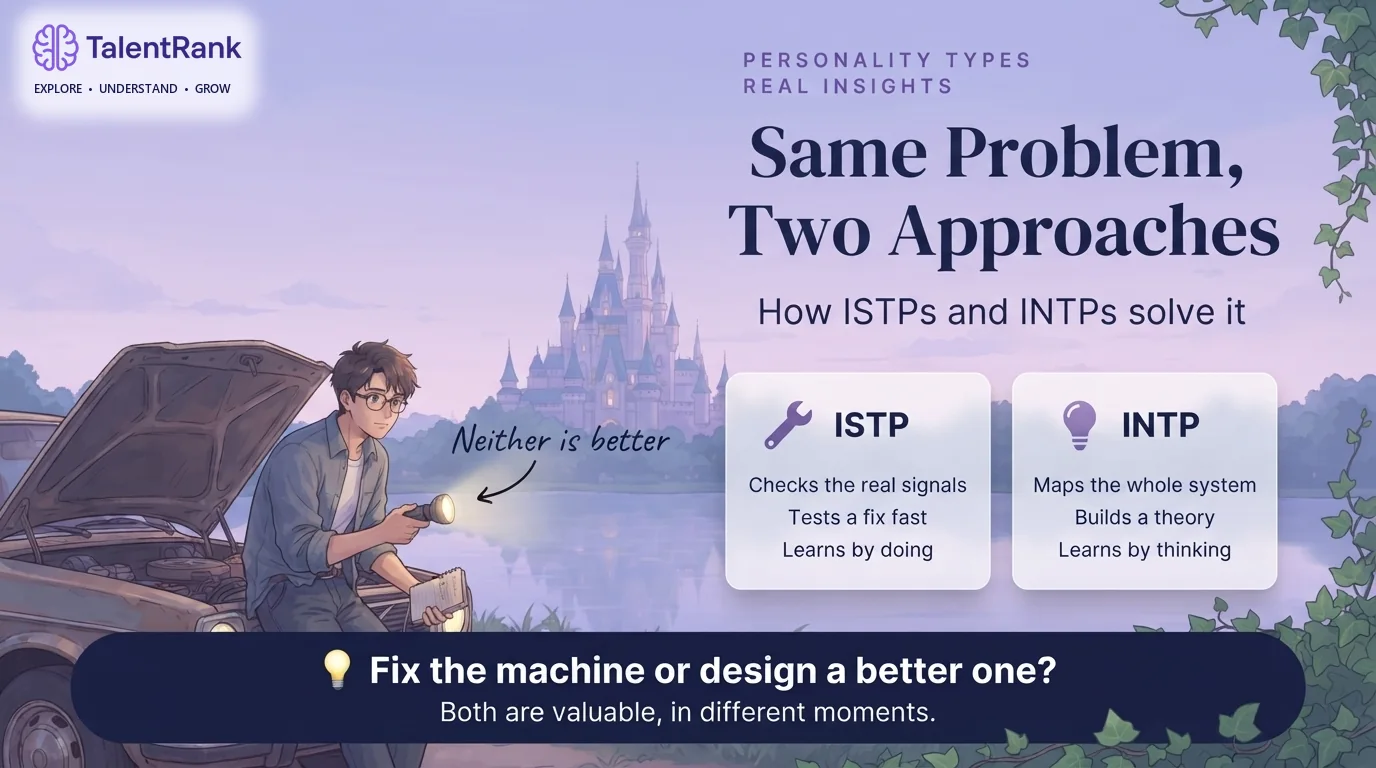
Imagine a car that won't start.
Hypothetical example: the ISTP opens the hood, checks the battery connection, listens to the starter, and has a working theory in minutes because they're reading real signals. The INTP may start by thinking about how the electrical system works as a whole, and they may find a root cause the ISTP missed, or they may still be reasoning when the ISTP has already fixed it.
Neither approach is better. ISTPs shine in emergencies and hands-on troubleshooting. INTPs shine when the problem is new, abstract, or needs a whole new framework.
ISTP vs INTP in Relationships
Both types value independence and space, and both show care through actions more than words. The difference is in what they share:
ISTPs tend to bond through shared activities: a road trip, a project, a sport.
INTPs tend to bond through shared ideas: long conversations, debates, and "what if" questions.
Both may struggle to talk about feelings on demand. For either type, a partner who respects alone time and doesn't read quiet as rejection makes a big difference.
ISTP vs INTP at Work
ISTPs often enjoy careers where they can see and touch the results: skilled trades, mechanics, emergency services, engineering, piloting, and hands-on technical roles. INTPs often lean toward research, software design, mathematics, and roles built around analysis and theory. (See our guide to INTP careers for more.)
Both types tend to dislike micromanagement and pointless rules. The key question for each: do you want to fix the machine, or design a better one?
How to Tell If You're ISTP or INTP
If you're torn between the two, these questions can help:
When you learn something new, do you want to try it right away, or understand the theory first?
Do you remember details and facts easily, or patterns and connections?
When you daydream, is it about something you could build or do, or about ideas and possibilities?
In a crisis, do you act immediately, or do you step back to analyze?
Does abstract theory feel energizing, or like a waste of time until it's useful?
If you mostly chose the first option, ISTP may fit better. If you chose the second, INTP may fit better. If your answers are split, that's normal: preferences exist on a spectrum, and many people sit near the middle of the S–N scale.
Common Mix-Ups
Assuming INTPs are smarter. Intuition describes what you pay attention to, not intelligence.
Assuming ISTPs are all adrenaline junkies. Many ISTPs are calm, careful, and patient.
Assuming INTPs can't do practical work. Plenty of INTPs are skilled engineers and makers.
Typing from hobbies alone. Liking motorcycles doesn't make someone an ISTP.
Beyond the Four Letters
If the ISTP vs INTP question is hard to settle, it may be because four letters can't capture where you fall on each scale. The Big Five model measures traits on a continuum instead. Openness to experience, for example, relates closely to interest in abstract ideas. (Our comparison of the Big Five and MBTI explains the difference.)
The TalentRank assessment measures your Big Five personality traits and takes about 12 to 15 minutes. It won't assign you ISTP or INTP, but it can show where you fall on traits like openness and conscientiousness, which often explain the difference better than a letter. Take the TalentRank assessment.
Frequently Asked Questions About ISTP vs INTP
What is the main difference between ISTP and INTP?
ISTPs prefer Sensing and focus on concrete, practical detail. INTPs prefer Intuition and focus on patterns and theory. Both lead with introverted Thinking.
Are ISTPs and INTPs compatible?
They often understand each other well, since both value independence and logic. The main friction point is pace: ISTPs may want to act while INTPs want to keep analyzing.
Which is rarer, ISTP or INTP?
Both are relatively uncommon in U.S. samples. Frequency estimates vary by study, so treat any single ranking with caution.
Can someone be both ISTP and INTP?
Not in the same result, but people near the middle of the Sensing–Intuition scale often test as either one on different days.
Do ISTP and INTP have the same cognitive functions?
They share the same dominant function, introverted Thinking. Their auxiliary functions differ: extraverted Sensing for ISTP and extraverted Intuition for INTP.
Final Takeaway
ISTP and INTP are close cousins: both logical, independent, and flexible. The difference is where their attention goes. ISTPs work with what's real and in front of them; INTPs work with what's possible and abstract. If you're unsure which fits, pay attention to how you learn and what kind of problem makes you lose track of time.