

A verbal reasoning test can catch you out with a sentence that sounds sensible. You recognize the topic, supply a missing detail from experience, and choose an answer the passage never established. Careful reading means noticing where the evidence ends, even when you feel confident about what probably happened.
Try the twelve original statements below before reading the answer key. Each set uses a short fictional workplace passage. Decide whether the statement follows from the passage, contradicts it, or needs information you have not been given. Then compare your reasoning with the explanation, including the exact detail that decides the answer.
What does a verbal reasoning test measure?
It assesses how you evaluate written information and draw conclusions from evidence. Formats vary. One familiar version gives a passage followed by statements and asks you to choose True, False, or Cannot Say. Other assessments may use different response options or tasks.
SHL's published Verbal Reasoning fact sheet describes evaluating statements from workplace passages. For your own assessment, check the named version and invitation before assuming its timing or navigation rules. SHL Verbal Reasoning fact sheet
Three answer rules for a verbal reasoning test
True: The information establishes the statement. You can point to evidence or a necessary inference.
False: The information establishes that the statement is incorrect. There is a contradiction.
Cannot Say: The information leaves the statement unresolved. It could be true or false without contradicting the passage.
The third category is where many tempting answers sit. A statement can sound likely and still be unresolved. If a company reports fewer delays after changing a process, that does not automatically establish that the process caused the improvement. Look for what the passage actually claims about the relationship.
Verbal reasoning practice test: three original passages
Answer all twelve items before checking the explanations. Treat the passages as complete evidence for these exercises. Their organizations, policies, and figures are fictional. You do not need business knowledge or information from another source.
Passage 1: A training policy
Northbridge Services requires every new employee to complete an online security course within ten working days of joining. Employees assigned to handle customer payments must also complete an in-person payments workshop before processing their first payment. Employees outside payment-handling roles are not required to attend that workshop. The workshop is offered every Tuesday. During May, six new employees joined the company. Four were assigned to process payments, and all six completed the online course within the required period. The passage gives no workshop attendance records.
1. Every new employee who joined in May completed the online security course on time.
2. Every new employee at Northbridge is required to complete the payments workshop.
3. All four employees assigned to process payments in May attended a workshop before processing payments.
4. At least two of May's new employees were not assigned to process payments.
Passage 2: Delivery performance
Hale Distribution delivered 800 orders in March and 1,000 orders in April. In March, 90% arrived by their promised date. In April, 92% arrived by their promised date. A routing system was introduced at the beginning of April. The operations team said the available figures did not isolate the effect of the routing system from other changes during the month. The company does not count an early delivery as late.
5. More orders arrived by their promised date in April than in March.
6. The proportion of late orders was higher in April than in March.
7. The new routing system caused the improvement in on-time delivery.
8. The number of late orders was the same in both months.
Passage 3: A flexible-working pilot
An engineering consultancy invited all 40 employees in its design department to join a three-month flexible-working pilot. Participation was voluntary, and 24 employees enrolled. Participants could work from home on up to two days each week, subject to client meetings. At the end of the pilot, 18 participants returned a survey. Of those respondents, 15 said the arrangement made it easier to organize their working week. Management has not announced whether the arrangement will become permanent.
9. Every employee in the design department joined the pilot.
10. More than half of the survey respondents said the arrangement made organizing their week easier.
11. All 24 participants found the arrangement helpful for organizing their week.
12. The consultancy has decided to make the arrangement permanent.
Verbal reasoning test answers and explanations
1. True. The passage explicitly says all six new employees completed the online course within the required period. “On time” is a paraphrase of meeting that deadline. A question does not need to repeat the passage word for word to be supported.
2. False. The workshop requirement applies to employees assigned to handle customer payments. The passage distinguishes that group from all new employees, and May's figures identify two new employees outside that assignment. Applying the workshop requirement to everyone contradicts the stated scope.
3. Cannot Say. A requirement tells you what employees must do. Attendance records would tell you what they actually did. The passage supplies no such records. Assuming perfect compliance would introduce a fact the exercise has not given you.
4. True. Six employees joined, and four were assigned to payments. Subtracting four from six gives two outside that group. “At least two” includes the established number of two, so the statement follows.
5. True. March had 800 × 90% = 720 on-time orders. April had 1,000 × 92% = 920. You need both the rate and the total to compare counts. In this example, April's count is higher by 200.
6. False. The late proportion was 10% in March and 8% in April. It fell. The question asks about proportion, so compare the complementary percentages rather than the overall number of orders.
7. Cannot Say. The system began when performance improved, but the passage explicitly says its effect was not isolated. The timing is consistent with several possible explanations. Evidence of a causal contribution would need more information.
8. True. March had 800 × 10% = 80 late orders. April had 1,000 × 8% = 80. The same count can accompany different proportions when the totals differ. Recheck whether the statement asks about count or rate before choosing an answer.
9. False. All 40 employees were invited, but only 24 enrolled. An invitation describes eligibility or opportunity. It does not establish participation. Here the stated enrollment directly contradicts “every employee.”
10. True. Fifteen of the eighteen respondents reported that benefit. Fifteen exceeds half of eighteen. The statement carefully limits its claim to respondents, which is the group described by the survey results.
11. Cannot Say. Fifteen respondents reported the benefit, while the passage does not establish the views of every participant. It also does not say that the other respondents rejected the benefit. The claim about all 24 remains unresolved.
12. Cannot Say. No announcement has been made, but that alone does not prove that no internal decision exists. Management could have decided without announcing it. A statement about the decision is unresolved on the evidence supplied.
How to review verbal reasoning questions
For each wrong answer, identify the exact jump in your reasoning. Did you turn an obligation into proof of compliance? Expand a survey result to a larger group? Treat a sequence of events as proof of causation? Those are different mistakes and deserve different practice.
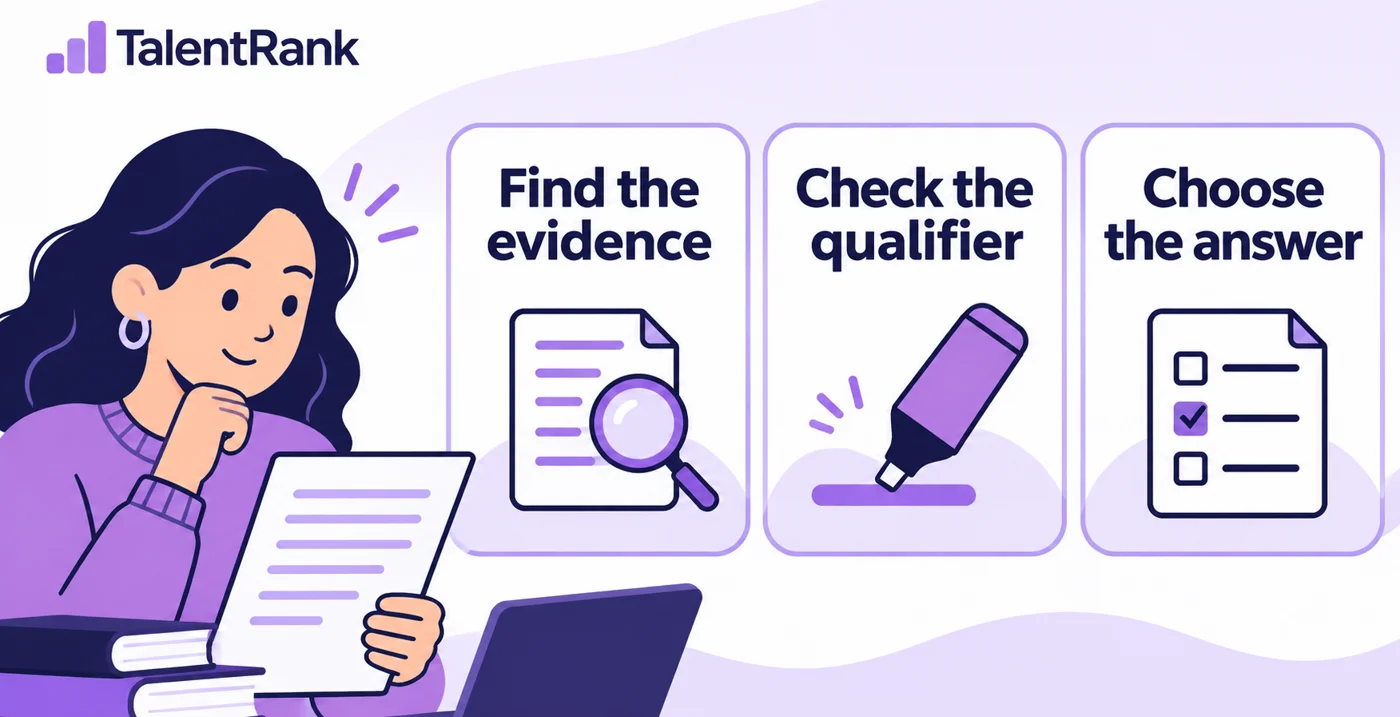
When reviewing a verbal reasoning test, write one sentence beside your answer: “The passage establishes this because…” or “The missing information is…” If you cannot finish either sentence clearly, reread the claim's scope and the passage's qualifiers.
Watch words that change the scope
Words such as all, some, only, before, and at least control what a statement claims. A verbal reasoning test may change one of these words while keeping most of the sentence familiar. Circle the qualifier and compare it with the corresponding sentence in the passage.
Distinguish a policy from an event
“Employees must complete training” states an obligation. “Employees completed training” reports an event. Keep the two separate unless the passage supplies compliance evidence. Apply the same care to plans, targets, forecasts, and completed results.
Before taking a verbal reasoning test
Check the invitation for the format and permitted tools. Use an official sample to learn the interface, especially whether answers can be revisited. Practise accurately without timing first, then use fresh passages at the pace your assessment specifies.
In your next verbal reasoning test practice session, record the sentence that supports each answer. A familiar passage can become a memory exercise after repeated attempts. Fresh passages help you check whether you can apply the evidence rules consistently.
Frequently asked questions
Does a verbal reasoning test check grammar?
The exercises here focus on conclusions drawn from written evidence. Grammar or vocabulary may appear in other assessment formats. Read your test description to learn which abilities and tasks are included.
Should I use outside knowledge?
For these exercises, use only the passage. A statement may match something you know about the real world while remaining unsupported by the fictional evidence. Follow the instructions supplied with your actual assessment.
Is a practice score a passing score?
These original questions provide learning feedback and have no validated passing score. Use your mistakes to choose your next drill. Your employer or assessment provider can explain the purpose of the actual result.
Make your next answer traceable
Pick one statement you missed and underline the smallest part that decides it. Then change a qualifier, group, or time period and check whether the answer changes. That gives you a concrete way to practise the reasoning behind the choice instead of memorizing an answer letter.