

You've always had one more question than everyone else in the room. The meeting wraps up, people are shuffling toward the door, and you're still turning the problem over, because you noticed a thread nobody pulled. Or maybe your version looks different: you get restless after about six months in any role, not because you're flakey, but because once the novelty drains out, something in you starts feeling “off”.
If this doesn’t sound like you, chances are you aren’t very high on this trait.
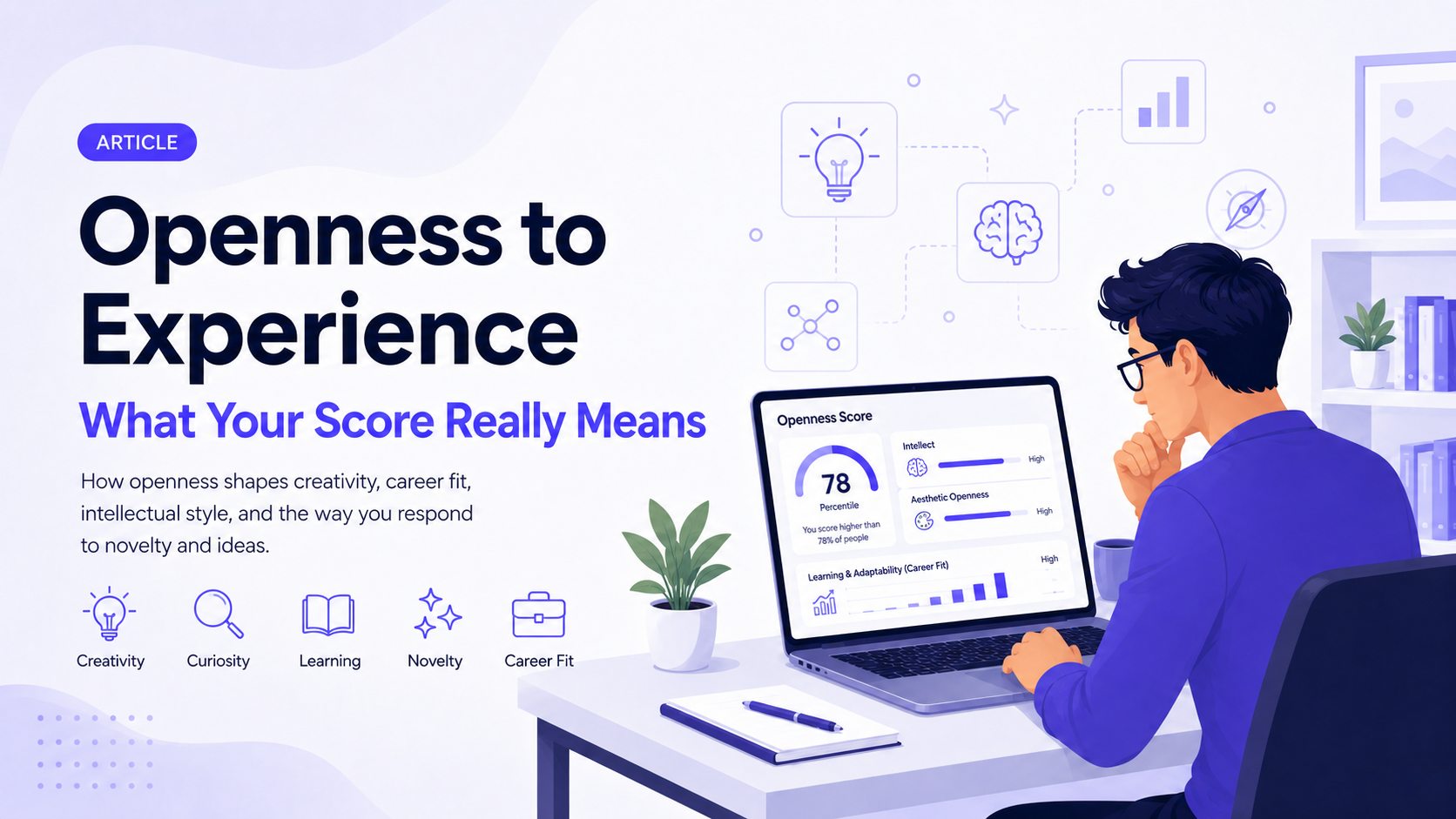
The pattern has a name. It shows up near the top of your openness to experience personality score, and it shapes more of your life than you probably realize.
Openness to Experience is one of the five dimensions in the Big Five model of personality, and at TalentRank we consider it the most intellectually interesting of the five. It predicts how you learn, what careers will actually sustain you, who you'll connect with romantically, and whether you'll thrive, or just survive, in certain environments.
What Openness to Experience Actually Measures
People often conflate Openness with being "open-minded" in the political or ideological sense. The two are worth separating. You can score high on Openness and be deeply opinionated, contrarian, or intellectually combative. What Openness measures is sensitivity to novelty, complexity, beauty, and ideas: a general appetite for experience that goes wider and deeper than average.
It is also worth separating from Agreeableness. High Openness says nothing about whether you're warm, accommodating, or conflict-averse. Some of the most disagreeable people you'll meet score very high on this dimension.
What Openness actually captures is a cluster of tendencies: you notice nuance others miss, you find abstract questions genuinely interesting, you're drawn to experiences that are complex or unfamiliar, and you have a richer-than-average inner imaginative life. Research by Colin DeYoung and colleagues identifies two separable aspects within Openness, and understanding them will help you read your own score more accurately.
The Intellect Facet
Intellect, in DeYoung's framework, is the personality disposition toward engaging with ideas. It shows up as intellectual curiosity, enjoyment of abstract thinking, quick pattern recognition, and a preference for complexity over simplicity. People high on Intellect find problems intrinsically rewarding. They like turning ideas over, finding the limits of a framework, and building new ones.
This is the facet that correlates most strongly with measured cognitive ability. DeYoung's research finds a correlation of approximately r = .30 between Intellect and IQ scores, which is modest but meaningful. High IQ amplifies what high Intellect produces: at average IQ, the combination tends to produce broad curiosity and wide-ranging interests. At high IQ, the same disposition produces the person who builds original frameworks and sees connections nobody else in the room has noticed yet.
If you're an INTJ or ENTP, you almost certainly scored high on this facet. MBTI's Intuitive (N) preference maps directly onto Openness, with Intellect being particularly prominent in thinking-intuitive types.
The Openness Facet
The second aspect is what DeYoung calls Openness proper: aesthetic sensitivity, imaginative absorption, and emotional responsiveness to art, beauty, and sensory experience. This is the facet that pulls toward museums, unconventional art, immersive fiction, music that operates on you before you understand why. People high on this aspect are permeated by beauty, not merely appreciative of it.
This facet tracks more with artistic and creative interests than with IQ. An INFJ or ENFP who scores high here is often drawn less to abstract philosophy than to the emotional texture of experience, the feeling that ordinary moments contain more than they appear to.
Scores on the two aspects can diverge considerably. A research scientist with no interest in music might be very high on Intellect and moderate on aesthetic Openness. A professional musician with little patience for theoretical abstraction might show the reverse pattern. Your overall Openness score tells part of the story; the facet breakdown tells the rest.
How it's measured: Both facets are captured through self-report questionnaires using Likert scales, asking how much you agree with statements about your own tendencies and preferences. At TalentRank, our assessment draws on validated Big Five methodology and presents your scores at both the trait and facet level, so you can see where your Openness actually lives.
The Openness Spectrum: Low to High
Scores are positions on a continuum, and what matters is what your position actually feels like from the inside.
If you scored in the 70th percentile or above, you probably experience a kind of low-grade restlessness in environments that don't offer novelty or intellectual stimulation. Routinized work feels like slow suffocation. You likely have a wider range of interests than most people you know, and you've probably been told at some point that you "overthink things," by people who weren't thinking about them enough. Learning new things isn't a chore for you; it's closer to eating. You may have a rich private inner life that you don't fully share with others.
If you scored between the 35th and 69th percentile, you sit in the broad middle range where most people land. You have intellectual interests but also value stability and predictability in certain domains of life. You handle novelty reasonably well without necessarily craving it. You're probably adaptable without being restless, curious without being overwhelmed by the number of directions you could go.
If you scored below the 35th percentile, you likely value mastery over novelty, reliability over experimentation, and the concrete over the abstract. You trust what has been proven to work. Low scorers are often misread as unimaginative, but the more accurate description is that they allocate cognitive energy toward depth in specific domains rather than breadth across many. ISTJ, ISFJ, and ESTJ types frequently land here, and these profiles are strongly correlated with reliability, precision, and skilled execution.
For a detailed breakdown of your score range, see:
[LINK: high-openness-variant-page] -- What it means to score in the top third
[LINK: medium-openness-variant-page] -- The middle range explained
[LINK: low-openness-variant-page] -- What low Openness actually predicts (and doesn't)
What Openness Predicts: Career, Relationships, and Health
Career
Openness is the weakest predictor of overall job performance among the Big Five (Barrick & Mount, 1991), which surprises people who assume curiosity and creativity would translate directly into productivity. They don't, at least not consistently. Where Openness does show strong predictive validity is training proficiency and learning speed: how quickly someone acquires new skills, adapts to shifting conditions, and builds expertise in unfamiliar domains.
The practical implication is straightforward. High-Openness people thrive in roles where the environment keeps changing and learning is continuous. They underperform in roles that have been fully optimized and require nothing but flawless repetition.
High scorers gravitate toward and tend to succeed in creative industries, research and development, strategy roles, entrepreneurship, academia, consulting, and any role where the problem set keeps evolving. Research by Zhao and Seibert (2006) found that Openness is among the personality traits that distinguish entrepreneurs from managers, with appetite for novelty and tolerance for ambiguity functioning as genuine differentiators.
Low scorers tend to excel in trades, operations, compliance, engineering disciplines with clear standards, finance roles requiring precision and consistency, and any domain where depth of mastery within a defined area matters more than breadth.
Neither profile is better. Every organization needs both. The mistake is forcing the wrong temperament into the wrong environment and calling the resulting friction a character flaw.
If you're deciding whether your current role is a fit, take the TalentRank assessment and get a report that matches your personality and cognitive profile to specific career environments.
Relationships
High-Openness people tend to need intellectual stimulation from their partners. Not in an elitist sense, just someone who takes ideas seriously, engages with complexity, and brings perspectives different from their own. A relationship that offers emotional warmth but no intellectual exchange will eventually feel hollow to them.
Low-Openness people tend to value stability, shared routines, and partners who are reliable and consistent. They often find high-Openness partners exciting initially and exhausting over time, particularly when those partners keep introducing new plans, new frameworks, or new enthusiasms into an environment the low-Openness partner had deliberately stabilized.
Mixed-Openness couples are common and can work well, but the friction pattern is predictable: the high-Openness partner feels constrained, the low-Openness partner feels destabilized, and neither fully understands why the other is reacting so strongly to something that seems minor. Naming this dynamic usually helps more than trying to change either person.
Health and Wellbeing
Openness is associated with greater willingness to explore therapy, try unconventional wellness practices, and engage with mental health as a legitimate domain of self-understanding. High scorers are more likely to seek psychological help when they need it.
There's a less comfortable side to this as well. High Openness is associated with higher rates of substance experimentation and greater susceptibility to certain mood-related vulnerabilities. The same sensitivity that makes you responsive to beauty and ideas makes you more responsive to disruption, overstimulation, and existential restlessness. This isn't a pathology, but it's worth knowing.
How Openness Interacts with Other Traits
Openness doesn't operate in isolation. Its expression is shaped substantially by what it's paired with.
High Openness + High Conscientiousness produces what might be called the strategic innovator: someone who generates original ideas and has the self-discipline to actually execute them. This combination is rarer than either trait alone and tends to produce unusually effective people in creative or intellectual fields.
High Openness + Low Conscientiousness produces the scattered creative: perpetually interesting, genuinely original, and reliably unfinished. The ideas are real. The follow-through is the problem. This combination is frustrating for the person living it and for the people depending on them.
High Openness + Low Agreeableness produces the contrarian intellectual: someone who thinks differently and is comfortable being adversarial about it. Original thinkers who challenge consensus, often correctly, and who don't particularly care whether the room agrees. This profile is overrepresented in research, philosophy, and political commentary.
The relationship between Openness and Extraversion is also worth noting. DeYoung's research groups both traits under a higher-order factor called "Plasticity," linked to dopaminergic systems involved in exploration and reward. High scorers on both dimensions (think ENFP or ENTP) tend to be especially energized by novelty and new social environments, because they're essentially getting a dopamine signal from two channels at once.
For more on how cognitive ability interacts with your personality profile, see [LINK: iq-cognitive-ability-pillar] and [LINK: mbti-bridge-page].
Can You Change Your Openness?
Honestly, not easily. Openness is roughly 50% heritable, meaning a substantial portion of your score reflects genetics rather than circumstance. It also tends to decline mildly across adulthood, not dramatically, but the 45-year-old version of you is statistically somewhat less Openness-driven than the 22-year-old version. More responsibilities, more established routines, less exposure to genuinely novel environments all play a role.
Attempts to directly increase Openness through intention or practice show modest effects at best. Conscientiousness responds more readily to behavioral systems and habit design. Openness is less malleable.
The more useful frame is environment selection. If you score high, your job is to find and stay in roles, relationships, and living environments that reward your need for novelty and intellectual stimulation, rather than spending your life fighting against your own temperament in a routine-driven environment that will slowly drain you. If you score low, your job is to recognize that you function best with stability, mastery, and predictability, and to stop apologizing for not being more "adventurous" by someone else's definition.
Your score is not a judgment. It's a description of your operating system.
FAQ
What does it mean to score high on Openness to Experience? It means you have a strong appetite for novelty, complexity, and intellectual or aesthetic stimulation. You learn quickly, grow restless in static environments, and tend to have broader interests than most people you know. It predicts creative ability, learning speed, and fit in research or entrepreneurial roles.
Is Openness the same as being open-minded? Open-minded in the political or social sense refers to willingness to consider other people's perspectives, which is closer to Agreeableness or intellectual humility. Openness to Experience is about appetite for novelty, aesthetic sensitivity, and engagement with ideas. A highly open person can be quite stubborn and opinionated.
What careers are best for high Openness? Roles where the problem set is constantly evolving: research, strategy, creative direction, entrepreneurship, academia, consulting, writing, design, and technology product development. Openness also predicts success in any role requiring rapid learning, since it's the strongest Big Five predictor of training proficiency.
What MBTI types are highest in Openness? Intuitive types (N) consistently score higher than Sensing types (S). The strongest associations are with INTJ, INFJ, ENTP, and ENFP. ISTJ, ISFJ, and ESTJ types tend to score lower, consistent with their preference for established methods and concrete information over abstraction and novelty.
Is Openness related to intelligence? Yes, modestly. The Intellect facet of Openness correlates with IQ at approximately r = .30 (DeYoung et al., 2005). Higher Openness is mildly associated with higher cognitive ability, but the two are clearly separable. High Openness at high IQ produces the profile of an original thinker. High IQ with lower Openness tends to produce skilled technicians and domain experts who apply intelligence with precision within established frameworks rather than building new ones.
Ready to see your own scores? Take the TalentRank assessment to get your full Big Five and ICAR cognitive profile, with an AI-generated report built specifically around your combination of traits.
Sources
DeYoung, C. G., Quilty, L. C., & Peterson, J. B. (2007). Between facets and domains: 10 aspects of the Big Five. Journal of Personality and Social Psychology, 93(5), 880-896.
DeYoung, C. G. (2013). The neuromodulator of exploration: A unifying theory of the role of dopamine in personality. Frontiers in Human Neuroscience, 7, 762.
Costa, P. T., & McCrae, R. R. (1989). The NEO PI/FFI manual supplement. Psychological Assessment Resources.
Barrick, M. R., & Mount, M. K. (1991). The Big Five personality dimensions and job performance: A meta-analysis. Personnel Psychology, 44(1), 1-26.
Zhao, H., & Seibert, S. E. (2006). The Big Five personality dimensions and entrepreneurial status: A meta-analytical review. Journal of Applied Psychology, 91(2), 259-271.
DeYoung, C. G., Peterson, J. B., & Higgins, D. M. (2005). Sources of Openness/Intellect: Cognitive and neuropsychological correlates of the fifth factor of personality. Journal of Personality, 73(4), 825-858.
McCrae, R. R. (1987). Creativity, divergent thinking, and openness to experience. Journal of Personality and Social Psychology, 52(6), 1258-1265.