

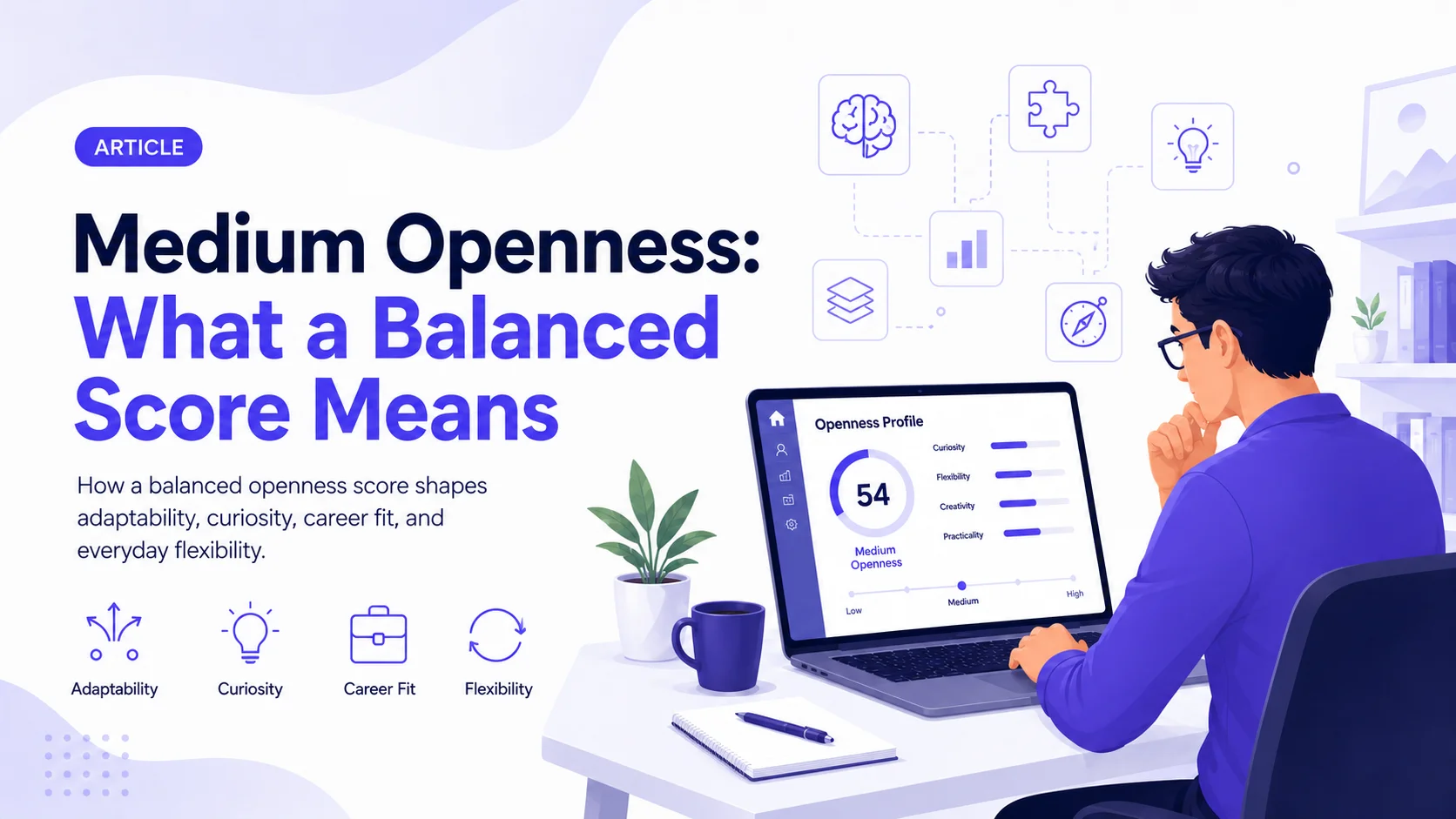
You probably read the descriptions of high and low Openness and thought "I'm kind of both, depending on the day." That can absolutely be true.
The moderate openness personality is the most common result on the Big Five, and it's also the most misunderstood. Most personality content is written for the extremes because extremes are easier to dramatize. High Openness gets described as the artist, the visionary, the person who wants to tear down structures and rebuild everything. Low Openness gets cast as the pragmatist, the executor, the person who trusts what works. You fell in the 35th to 69th percentile, which means neither archetype is quite right, and you've probably known that for a while.
What Medium Openness Feels Like
You enjoy new experiences, but you don't need constant novelty to feel engaged. A weekend trip somewhere unfamiliar sounds appealing. A life of permanent reinvention sounds exhausting. You can sit with a familiar routine for months and feel fine, and you can also get excited when something unexpected comes your way.
You're intellectually curious, but it tends to run deep in one or two directions rather than scattering across everything. You're not the person who has twelve ongoing obsessions. You might have one or two subjects you return to repeatedly, and you engage with them seriously.
Creative work isn't the center of your identity. You can appreciate it, participate in it, even produce it when the context calls for it. But you're not driven by a constant need to express or create. And that's fine.
The more useful frame for your score is flexibility. A high-Openness person is often genuinely poorly matched to structured, procedural environments. They get restless. A low-Openness person can feel genuinely out of place in roles that require constant improvisation and creative problem-solving. You don't have either constraint. You can walk into a brainstorming meeting and contribute real ideas. You can also sit down and execute a detailed process correctly, repeatedly, without losing your mind. That range of comfort is undervalued.
Medium Openness at Work
The career advantage here is adaptability, and it's a real one.
High-Openness people sometimes struggle in roles that are heavily procedural, compliance-driven, or routine-based. They're good at generating ideas and poor at tolerating the same task for the hundredth time. Low-Openness people can struggle in roles that require rapid improvisation, comfort with ambiguity, or regular reinvention of how work gets done. You don't bump into either wall.
This opens up a genuinely wide range of career environments. Project management, business development, education, healthcare administration, mid-level and senior management, marketing, technical roles with meaningful variety, operations with a creative layer. These aren't careers that require extraordinary Openness, but they also aren't careers that punish Openness. They reward people who can move between creative and procedural modes without losing momentum. That's you.
The work environment that suits a moderate Openness score tends to have a stable core with periodic novelty. A role where the fundamentals are consistent but new challenges emerge regularly, where you're not reinventing your job every quarter but also not doing the exact same thing every single day. That structure-plus-variety combination is actually how most good jobs are designed. You're matched to the mainstream of professional work.
Here's the real career question for people with your profile: it's not "which careers suit my Openness score?" Because many do. The stronger signal is which of your other traits are pulling hardest. For most people in the moderate Openness range, Conscientiousness is the dominant career predictor. If you're high Conscientiousness, you'll succeed in almost any professional environment because you're reliable, thorough, and self-directed. If you're low Conscientiousness, no amount of career-fit optimization will substitute for building better structure and follow-through. Extraversion matters enormously for client-facing, leadership, and sales roles. Agreeableness shapes how well you manage up, manage down, and work in teams. For you, those four traits are the real story. Openness is background.
On the MBTI bridging point: if you've ever taken the Myers-Briggs and felt like the S/N dimension didn't quite fit, this might explain it. The Sensing-Intuition spectrum roughly corresponds to low versus high Openness. At your score, you're genuinely near the boundary. You might have tested as ISFJ on one administration and INFJ on another. Both could technically fit. That's not the test failing. That's what a true midpoint looks like.
Medium Openness in Relationships
You're compatible with a broader range of partners than either extreme. A highly creative, intellectually restless partner won't overwhelm you. You can follow their tangents, engage with their ideas, appreciate the originality without feeling like you're being dragged somewhere you don't want to go. A highly practical, routine-oriented partner won't bore you into the floor either. You can share in the comfort of a stable life without needing constant stimulation to feel connected.
That range of compatibility is useful. It means you're not selecting for a narrow type.
Where friction occasionally shows up is in how other people read you. Around high-Openness people, you might sometimes feel "not creative enough," like you're the one pumping the brakes on an idea or preferring the known option. Around very low-Openness people, you might come across as unpredictable or overly open to change. Neither perception is accurate. But both can create friction until the people around you understand your actual profile.
The practical fix is usually just naming it. You're not resistant to creativity. You're not chaotic. You're flexible, and flexibility reads differently to people at the extremes.
Medium Openness Combined with Other Traits
For people in your range, the combination of Openness with another strong trait is almost always the better predictor of how you actually show up. Two combinations worth understanding:
Medium Openness with High Conscientiousness produces what we'd describe as the reliable professional who innovates when needed. You don't require novelty to stay engaged, and you're disciplined enough to execute over the long term. You won't design the product from scratch, but you'll own the process of getting it built correctly. Senior individual contributor roles, operations leadership, and technical project management are natural fits.
Medium Openness with High Extraversion produces the sociable generalist. You're comfortable in many environments, you adapt quickly to new people and contexts, and you're well-liked across a range of social settings. This combination is particularly strong in roles that require moving between different teams or stakeholders without losing social capital. Business development, account management, education, and cross-functional leadership all leverage this well.
Both combinations are worth exploring if either resonates with your other results. At TalentRank, the full report accounts for all five trait interactions, which is where the real precision comes from.
Common Challenges and Growth Areas
One real challenge for moderate-Openness people is identity in a culture that rewards clearly defined types. The popular narrative is that you're either a creative visionary or a disciplined executor. Silicon Valley celebrates the former. Traditional professional culture celebrates the latter. Neither has a clean archetype for "versatile, works well across contexts, doesn't need to be at either extreme." But that's the honest description of your profile, and it's worth owning rather than trying to perform one of the extremes.
The other challenge is decision-making. When you score at the extremes on any Big Five trait, the trait itself acts as a filter. A high-Openness person can quickly eliminate careers that are too routine. A low-Openness person can quickly eliminate careers that are too unstructured. At moderate Openness, more options remain technically viable, and that makes it harder to narrow down.
The solution isn't to manufacture a strong preference you don't have. It's to look harder at your other traits and at what you actually want from work beyond intellectual stimulation. Lifestyle, compensation, autonomy, advancement structure, the kind of people you want to work with. Medium Openness people often need to do more explicit values-clarification work to identify the right path, because their trait profile doesn't rule out as many options as the extremes do.
FAQ
Is medium openness normal?
Yes. The 35th to 69th percentile is by definition the most populated range on any normally distributed trait. More people score here than anywhere else. "Normal" in the statistical sense and "common" in the practical sense both apply. What this range doesn't mean is generic. Distribution tells you how frequent a score is, not how meaningful it is.
What careers suit moderate openness?
A wide range. The more productive question is which careers suit your full trait profile. That said, roles with a stable core and periodic variety tend to fit best: project management, healthcare, education, business development, mid-level management, technical roles with cross-functional exposure. Roles that require either constant creative reinvention or pure procedural repetition are less ideal, but neither is a hard disqualifier.
Does medium openness mean I'm not creative?
No. Creativity isn't a high-Openness monopoly. Research on Big Five and creative performance consistently shows that Conscientiousness and domain-specific training are as important as Openness for producing creative output (Feist, 1998; Silvia et al., 2009). High Openness predicts the drive to seek creative experiences. It doesn't predict the quality of what you produce. Plenty of highly productive creative professionals score exactly where you do.
If you want to understand what your Openness score means in combination with your other four traits, the full TalentRank report gives you a complete picture. That's where the real signal is.