
You've probably heard some version of "you have so much potential if you'd just apply yourself" at least a dozen times in your life. From teachers. From parents. From managers who watched you produce brilliant work in two frantic hours while ignoring every task on your to-do list for the three weeks before that.
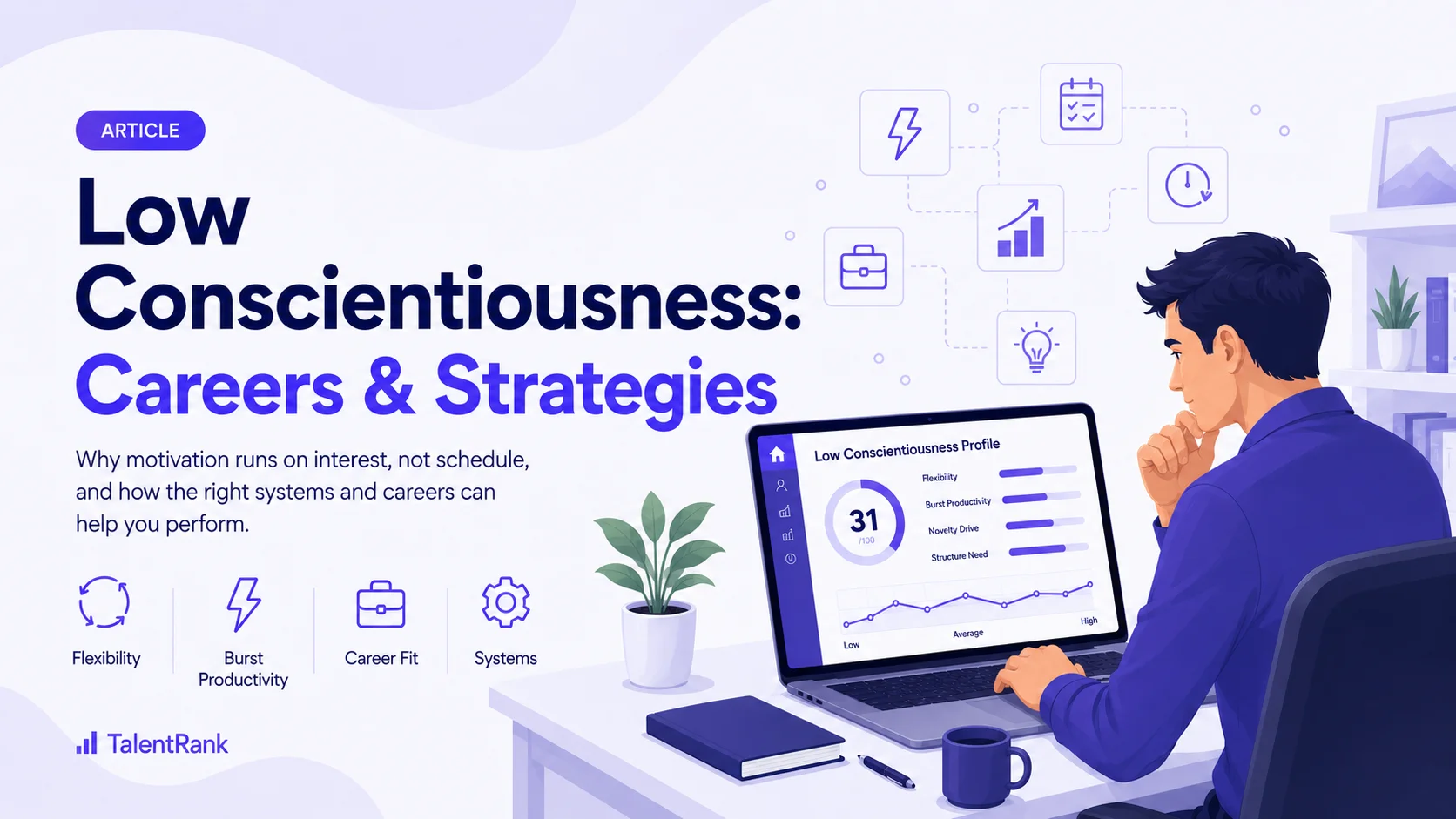
Low conscientiousness is one of the most misunderstood personality profiles in the Big Five. The standard narrative is punishing: undisciplined, unreliable, destined to underperform. That narrative is also incomplete. If you score in the 1st to 34th percentile on conscientiousness, you're not broken. Your motivation system runs on a different fuel source than the system most conventional environments are built to reward.
It’s also important (albeit slightly deterministic) to know that conscientiousness is difficult to change. Most likely, when you’re attempting to become more structured, it will always feel like an uphill battle. It can be done through changing your environment and creating positive feedback loops, but generally low-C people won’t take the necessary time or effort to do that.
Rather than try to change your nature, we’d prefer you understood how you operate so you can put yourself in environments where it’s acceptable and rewarded.
What Low Conscientiousness Feels Like
Plans feel constraining in a way that's hard to explain to people who find comfort in them. You make schedules with the best intentions and then watch them become irrelevant by noon. Deadlines that feel abstract don't register the way real urgency does. But put a genuine crisis in front of you, or a problem that actually interests you, and something clicks. The same person who couldn't finish a routine report can spend nine hours straight solving a problem that grabbed them.
You probably work in bursts. Periods of intense, almost manic productivity followed by stretches where forward motion is nearly impossible. Starting things comes easily. Finishing them, especially once the interesting part is over, is where things fall apart. Your desk, your files, your inbox, your apartment, possibly all of the above, might be what other people would call chaotic. You know where things are. Sort of.
Here's what the research actually says: low conscientiousness doesn't necessarily mean lazy. It means your motivational system responds to interest and urgency rather than duty and schedule. You're not deficient in willpower, but it can feel like you're running on a different operating system than others.
Barrick and Mount's landmark 1991 meta-analysis established conscientiousness as the most consistent Big Five predictor of job performance across occupations. But "across occupations" is doing a lot of work in that sentence. Fit matters enormously, and the roles where conscientiousness predicts performance most strongly are roles built around routine, compliance, and steady incremental output. Fortunately, there are many other roles.
Low Conscientiousness at Work
The honest answer is that a traditional structured corporate environment is probably going to grind you down. Long-horizon projects with no external accountability, bureaucratic processes that reward consistency over insight, roles where showing up the same way every day is the entire job. These environments aren’t really made for you.
The environments where low conscientiousness becomes a non-issue, or even an advantage, share a few things: external structure that substitutes for internal discipline, real stakes or genuine novelty that trigger natural engagement, and flexibility in how and when work gets done rather than rigid process requirements.
Creative roles with external deadlines are a natural fit. Journalism is a good example. You have a story, a deadline that is real and public, and the work itself is different every time. Freelancing works for similar reasons: the deadline is the client, the variety keeps interest alive, and you're rewarded for output rather than hours logged. Commission-based sales roles have the same structure. The urgency is built in. The feedback is immediate. High performers in those environments tend to be people who run exactly the motivation system you have.
Entrepreneurship, especially in its early chaotic stages, suits low-conscientiousness profiles more than people expect. The startup environment rewards fluid thinking, pivoting, and the ability to work in short intense bursts toward shifting targets. The skills that hurt you in a corporate compliance role are close to the skills that keep a scrappy early-stage company alive. And crisis work, emergency medicine, emergency response, incident management, favors people who thrive under pressure and don't need routine to function.
What to avoid: roles with long unbroken project timelines and no milestones, environments where the primary performance signal is process compliance, and any job where "did you follow the procedure" matters more than "did you produce something good."
Roberts and Inzlicht's 2024 research on self-regulation offers a useful principle for low-conscientiousness people trying to perform in structured environments: don't try to willpower your way through. The evidence for willpower as a depletable resource has weakened, but the core finding holds. Brute-forcing internal discipline in a mismatched environment doesn’t actually work. Build external structure instead. Accountability partners, public commitments, automation that removes decisions, smaller work chunks with real deadlines. Stop fighting your own operating system and engineer around it.
In MBTI terms, Perceiving types (ENFP, ENTP, INFP, INTP) typically score lower on conscientiousness. If you've typed as a P and found the description accurate, the Big Five data aligns with what you already know about yourself.
Low Conscientiousness in Relationships
The friction is real. Forgotten commitments aren't malicious, but they land that way. Partners who are high in conscientiousness, people who keep mental calendars and follow through on small promises as a matter of course, can experience a low-C partner as careless or chronically unreliable. That read isn't entirely wrong. And pretending there's no cost to inconsistent follow-through isn’t true. This matters a lot to people who wouldn’t do the same thing to someone else.
What's worth naming is that this is how your system works, but that’s not an excuse. But understanding that you're not choosing to forget, that your brain doesn't maintain the same persistent background tracking of obligations that high-C people carry automatically, is the starting point for building workarounds rather than just apologizing endlessly.
The strengths are worth naming too. You're not rigid. You adapt. Plans change and you're not devastated by it. Spontaneity is real, not performed. Partners who value flexibility, who find highly scheduled life suffocating, often find low-conscientiousness people refreshing rather than frustrating. The fit matters here the same way it does in work environments.
Low Conscientiousness Combined with Other Traits
Personality profiles don't operate in isolation. Low conscientiousness combined with high openness to experience produces what you might call creative chaos: someone full of ideas, connections, and generative energy who struggles badly with follow-through. The combination can be great in the right context. It can also be a trail of 80%-finished projects if there's no external structure or a high-C person in the room.
Low conscientiousness with high IQ is a particularly tricky configuration. You're smart enough to coast and often do. The challenge is that being able to produce acceptable work without full effort tends to mean you never find out what full effort could produce. "Brilliant underperformer" is a cliche because it maps onto a real pattern. The work is good enough and then it stops.
Low conscientiousness with high extraversion creates an energetic starter. You launch things. You get people excited. You fill rooms. And then the next thing comes along and the first thing goes quiet. This combination thrives with co-founders, collaborators, or team structures that provide continuity and execution.
Common Challenges and Growth Areas
The deterministic read on conscientiousness, that you have it or you don't, isn't what the research shows. Hudson's 2021 longitudinal work found that conscientiousness is among the most changeable personality traits in adulthood, shifting meaningfully in response to new roles, environmental demands, and deliberate behavioral practice. It doesn't change overnight but it can gradually.
Small behavioral repetition is where the evidence points. Not sweeping system overhauls. Not new year commitments. One small habit, practiced until it's automatic, repeated. Making your bed. Closing your tabs. Responding to one email before opening anything new. Over months, stacked, they begin to shift the underlying pattern.
The more practical intervention for most low-conscientiousness people is environmental design rather than character change. Automate whatever you can. Use tools that create external accountability. Break large vague projects into small pieces with real deadlines attached to each piece. Work with people who are strong where you're weak. If your profile combines low conscientiousness with high openness or high IQ, your comparative advantage is in idea generation, pattern recognition, and creative problem-solving. Execution and follow-through are things you can hire for, delegate, or build partnerships around. Trying to be equally strong everywhere is a worse strategy than knowing where you're genuinely hard to replace.
The trap is treating low conscientiousness as something to be fixed before you're allowed to succeed. The more useful frame is building a life and work environment where your actual strengths do most of the work, and where the gaps are covered by systems and people rather than by grinding against your own personality.
Frequently Asked Questions
Is low conscientiousness bad?
Not categorically. It depends entirely on context. Low conscientiousness predicts lower performance in highly structured roles that require routine, long-term planning, and consistent self-regulation. In creative, entrepreneurial, crisis-oriented, or highly variable work environments, the same profile is far less of a disadvantage and can correlate with strengths like flexibility, novelty-seeking, and burst productivity. The research on conscientiousness and job performance (Barrick and Mount 1991) is robust, but it reflects aggregate patterns across roles, not a verdict on individuals.
What jobs are best for low conscientiousness?
Creative roles with real external deadlines, commission-based sales, journalism, freelancing, entrepreneurship (particularly early-stage), emergency and crisis-oriented work, and startups tend to suit low-conscientiousness profiles. These environments provide external structure, genuine urgency, and flexibility in how work gets done, which substitutes for the internal discipline that high-C environments assume.
Can I become more conscientious?
Yes, to a degree. Hudson's 2021 research found that conscientiousness is one of the more changeable Big Five traits in adulthood. Change happens through consistent behavioral repetition over time, not through willpower or insight alone. The practical approach is small habits practiced until automatic, combined with environmental design that reduces reliance on internal discipline. Partnering with high-conscientiousness people for execution while focusing on your own strengths is often a faster path to results than trying to fully close the gap through personal development.
Want to know how your conscientiousness score combines with your other Big Five traits? Take the TalentRank assessment to get your full personality profile and a personalized Blueprint.
Sources
Barrick, M. R., and Mount, M. K. (1991). The Big Five personality dimensions and job performance: A meta-analysis. Personnel Psychology, 44(1), 1-26.
Hudson, N. W. (2021). Does successfully changing personality traits via intervention require that participants be motivated to change those traits? Journal of Research in Personality, 91, 104078.
Roberts, B. W., and Inzlicht, M. (2024). Self-regulation and the Big Five: Implications for personality change and performance. Psychological Review.