

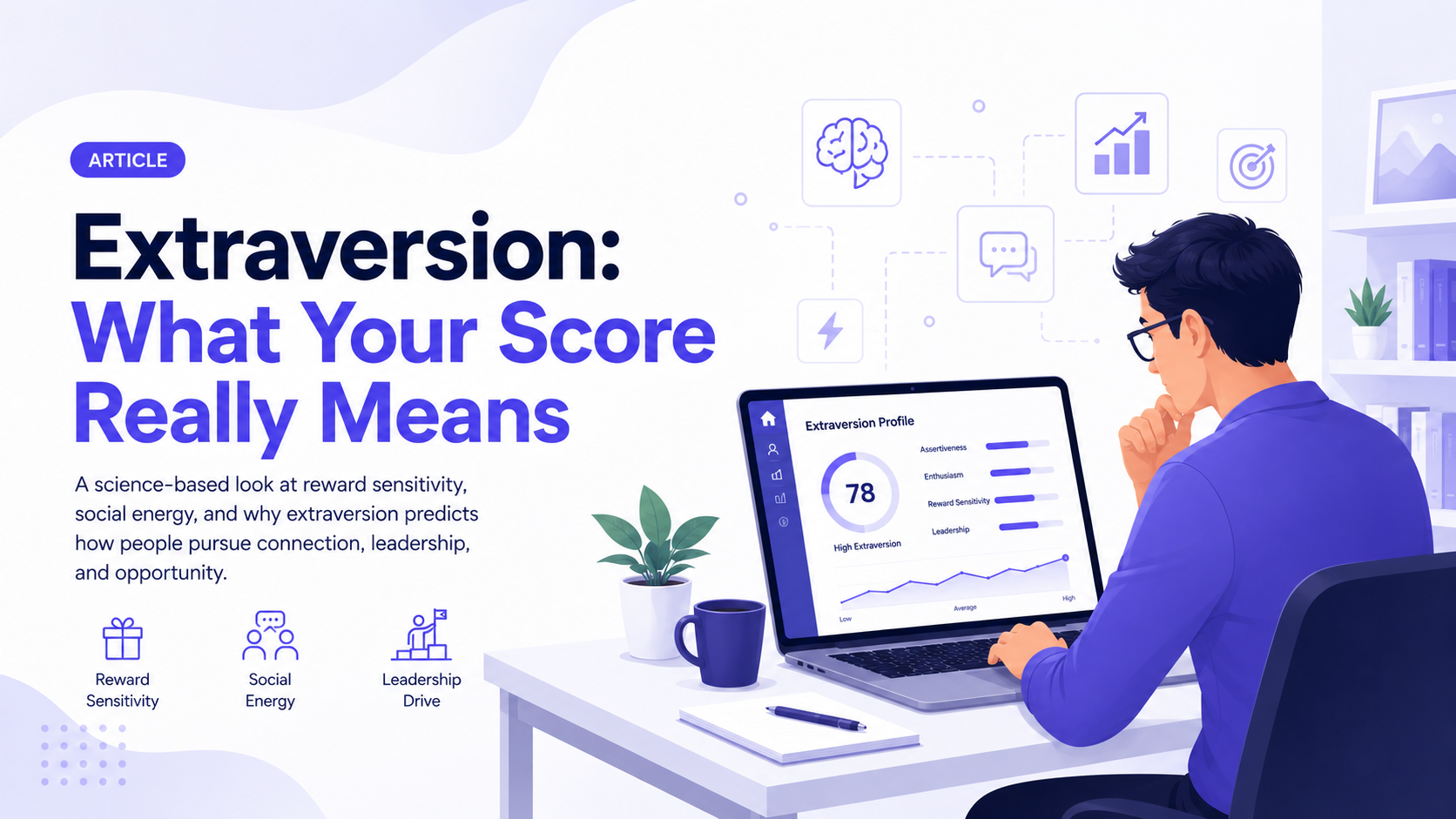
You've been told extraversion is about how much you like being around people. Perhaps surprisingly, that's not what it actually measures.
The real story is about reward sensitivity, dopamine, and why two people with identical scores can look completely different in daily life. Here is what the science actually says.
What Extraversion Actually Measures
The pop psychology version of extraversion is simple: extraverts like people, introverts prefer solitude, and somewhere in the middle you get ambiverts who can tolerate both. This is not wrong exactly, but it misses the mechanism entirely. Knowing the mechanism is what makes your score useful.
You may have heard the oversimplified take of “extraverts recharge around people, introverts recharge alone” and while they’re some accuracy to that, it’s a pretty bad summary of what’s actually happening.
Extraversion, as defined in Big Five research, is fundamentally about approach motivation and reward sensitivity. People high in extraversion have a more reactive dopaminergic reward system. When they encounter potential rewards, whether social attention, competitive achievement, or new opportunities, their brains respond more strongly. They approach. They engage. They pursue.
This is why extraverts feel energized in stimulating environments and introverts feel drained. It is not that extraverts have more energy. It is that the same stimuli produce a stronger reward signal in extraverted brains, making the cost-to-benefit ratio of engagement feel very different. Research by Smillie and colleagues (2019) confirmed that extraversion predicts reward-related positive affect, not simply sociability.
Eysenck's arousal theory offered an earlier and different framing: introverts have higher baseline cortical arousal, which means external stimulation pushes them toward overload faster. This model is real and useful. But the reward-sensitivity account developed by DeYoung (2013), drawing on Depue and Collins (1999), is considered the more comprehensive explanation of why the trait affects so many domains of behavior beyond just social preference.
Extraverts don't have more energy. They have a stronger reward signal from the same stimuli. The social battery metaphor describes the symptom. It doesn't explain the mechanism.
Within extraversion, personality research has identified two distinct aspects that can and do come apart. DeYoung and colleagues (2007) labeled these Assertiveness and Enthusiasm, and understanding the difference between them explains a great deal of confusion about the trait.
Assertiveness
The drive toward goals, status, and dominance. Assertiveness covers leadership emergence, persuasiveness, competitive motivation, and the tendency to take charge in groups. This is the aspect of extraversion that predicts income and career advancement most directly. It is mediated by the dopaminergic system, specifically the incentive reward or "wanting" pathway.
Enthusiasm
The drive toward affiliation, warmth, and shared positive emotion. Enthusiasm covers gregariousness, sociability, expressiveness, and the genuine pleasure of being around people. High enthusiasm produces the person who lights up a room and never meets a stranger. It is mediated by the opioid system, the consummatory reward or "liking" pathway, which is neurobiologically distinct from the dopamine system underlying Assertiveness.
These two aspects are related but separate. Someone can score high on Assertiveness while sitting in the moderate range on Enthusiasm. This person takes charge, speaks up, competes hard, and pursues achievement aggressively, but does not particularly need to be everyone's friend or spend their weekends at parties. They look very different from someone high on both, or high on Enthusiasm and lower on Assertiveness, who is warm, sociable, and beloved, but who avoids conflict and rarely pushes to lead.
This also explains why introverts often enjoy one-on-one conversations and detest large social gatherings. It is not a contradiction. In a focused, intimate conversation, the reward-to-cost ratio is favorable: deep exchange, intellectual stimulation, real connection. In a crowded room of small talk, the cost of stimulation management exceeds the reward.
The Extraversion Spectrum: Low to High
Extraversion is a continuous trait, not a binary category. Most people fall somewhere in the middle, with the extreme ends representing a relatively small portion of the population.
Low Extraversion (Introversion) Strongly prefers depth over breadth. Thinks before speaking. Needs significant recovery time after social engagement. Strongest work is often done in solitude. May be misread as cold or disengaged when simply managing stimulation load. [Read: Low Extraversion Profile]
Moderate Extraversion Adapts to context. Can lead when needed, withdraw when it suits them. Neither strongly energized nor strongly drained by social exposure. The majority of people fall in this range. Context and interest level matter more than baseline trait level. [Read: Moderate Extraversion Profile]
High Extraversion Seeks stimulation, connection, and challenge. Feels flat in understimulating environments. Naturally takes up space in groups. May underestimate how much social engagement costs others, or confuse their own energy levels with universal ones. [Read: High Extraversion Profile]
The High-Assertiveness, Low-Enthusiasm variant is worth calling out specifically. This profile, found in many senior executives and competitive entrepreneurs, registers as extraverted on standardized measures because of its approach-motivation and dominance components, but may read as introverted on some pop-psychology assessments because it lacks the warm sociability typically associated with the trait. The science distinguishes them. Your score should too.
What Extraversion Predicts: Career, Relationships, and Health
Career
The career evidence on extraversion is among the more robust in personality psychology. Judge and colleagues (2002) found that extraversion is the strongest Big Five predictor of leadership emergence across studies. Extraverts get promoted faster, earn more on average, and are more likely to be identified as leaders by peers and supervisors.
Critically, most of this career advantage is driven by the Assertiveness aspect, not Enthusiasm. The person who speaks up in meetings, pursues visibility, and is comfortable with competitive dynamics advances faster. Raw sociability, the Enthusiasm component, matters much less for career outcomes than commonly assumed.
Barrick and Mount (1991) found that extraversion predicts job performance specifically in roles requiring social interaction: management, sales, and customer-facing positions. For roles requiring deep independent work, technical mastery, or analytical precision, introversion is often the asset. Research, software development, finance, writing, and many specialist roles tend to select for introverted or moderate profiles.
Domain | What the Research Shows |
Leadership | Strongest Big Five predictor of leadership emergence. Primarily driven by Assertiveness, not Enthusiasm. Effect size holds across cultures and organizational levels. |
Income | Extraverts earn modestly more on average, largely explained by promotion velocity and willingness to negotiate. Effect diminishes in fields where performance is objectively measured. |
Sales | Moderate extraversion predicts sales performance better than extreme extraversion. Very high scorers can overtalk and undersell. Ambiverts often outperform both ends of the spectrum. |
Technical Roles | Low extraversion predicts sustained focus, lower need for external stimulation, and preference for depth over breadth. Strong advantage in research, engineering, and analytical work. |
Key sources: Judge et al. (2002), Barrick and Mount (1991)
Relationships
Extraverts report higher average relationship satisfaction, but this effect is partially explained by the positive emotionality component of the trait rather than anything specific to relationship quality. Extraverts experience and express more positive affect generally, which inflates self-reported satisfaction across domains.
Mixed-Extraversion couples face a specific and well-documented challenge: one partner's baseline need for social stimulation does not match the other's. This is not a character flaw on either side. It is a difference in reward systems. The solution is structural, setting clear norms around social schedules and alone time, rather than hoping the other person will naturally adjust.
Health and Wellbeing
Extraversion shows a modest positive association with subjective wellbeing and self-reported happiness. This finding is among the most replicated in personality psychology. However, the interpretation requires care. Standard happiness measures emphasize positive affect, which extraverts experience more frequently by definition, making the correlation partly circular. Introverts report lower positive affect, not necessarily lower satisfaction with their lives overall.
MBTI Connection: The E/I dimension in MBTI maps almost perfectly onto Big Five Extraversion, with Costa and McCrae (1989) establishing the correspondence nearly forty years ago. If you are typed as ENTJ, ENFP, or ESTP, you are almost certainly above the 60th percentile on Extraversion. If you are typed as INTJ, INFP, or ISTP, you are likely below the 40th. The Big Five score adds precision that MBTI types cannot: it tells you where exactly you fall on the continuum, and crucially, whether your score reflects high Assertiveness, high Enthusiasm, or both.
How Extraversion Interacts with Other Traits
Extraversion does not operate in isolation. Its effects are amplified, redirected, or constrained by the other four Big Five traits. Some of the most predictive personality profiles in career and leadership research involve specific combinations.
High Extraversion + Low Agreeableness: The Dominant Leader Approach motivation without the social deference of high Agreeableness produces the competitive, results-oriented executive. This combination is overrepresented in senior leadership and entrepreneurship. It comes with real strengths in negotiation and decisive action, and real risks around conflict generation and team dynamics.
High Extraversion + High Openness: The Charismatic Innovator DeYoung identified Extraversion and Openness as sharing a common higher-order factor called Plasticity, reflecting a general tendency toward engagement and exploration. The combination produces creative, socially effective individuals who generate ideas and sell them. Strong in communications, design, entrepreneurship, and any field that rewards both originality and persuasion.
Low Extraversion + High Conscientiousness: The Quiet Achiever Low reward-seeking paired with high self-discipline produces individuals who deliver consistently without requiring external recognition to stay motivated. This combination is underrated in discussions of high performance. It predicts sustained output in technical fields, research, finance, and any role where depth matters more than visibility.
There is also a useful interaction with cognitive ability worth naming directly. Extraversion shapes how intelligence gets deployed in the world. An extravert of average IQ who speaks confidently in meetings, takes credit effectively, and builds strong networks will often advance faster than a quieter person of high IQ whose best thinking happens in writing. This is not a statement about fairness. It is an accurate description of how most organizations work, and one reason why raw intelligence, without the personality traits that make it visible, predicts less career success than most people assume.
Can You Change Your Extraversion?
Extraversion is among the more heritable of the Big Five traits, with twin studies placing heritability estimates around 50 percent. It is also one of the more stable traits across adulthood, though modest declines tend to occur naturally as people age through their forties and fifties, a pattern researchers sometimes call "personality maturation."
Deliberate behavioral interventions targeting extraversion directly are less studied and generally less effective than comparable work on Conscientiousness. You can build habits. You can train discipline. Rewiring your baseline reward sensitivity is a different and considerably harder project.
The more productive frame is environment selection. Finding roles, relationships, and work structures that match your natural level of extraversion is almost always more effective than forcing yourself to operate against type. An introvert who structures their day around focused solo work and deploys social skills in contained, high-stakes situations, negotiations, presentations, key meetings, will outperform an introvert who spends eight hours in an open-plan office grinding against their own reward system.
That said, social skills are learnable even when the underlying trait is stable. An introvert who develops strong presentation skills, networking behaviors, and conversational fluency has not changed their Extraversion score. They have expanded their behavioral range. The key distinction is that deploying those skills costs them more than it costs a natural extravert. Sustainable performance requires accounting for that cost, not pretending it does not exist.
Frequently Asked Questions
What is the difference between extraversion and introversion? Introversion and extraversion are opposite ends of the same continuous trait. Extraverts have stronger approach motivation and reward sensitivity, particularly in social and achievement contexts. Introverts have lower reward response to those same stimuli and often higher sensitivity to overstimulation. Neither pole is healthier or more functional. They represent different cost-benefit calculations for the same environments.
Is extraversion just about being social? No. Sociability is the most visible expression of extraversion, but the trait also covers leadership drive, competitive motivation, positive emotionality, talkativeness, and energy in stimulating environments. The Assertiveness aspect of extraversion has almost nothing to do with how much you enjoy parties. It predicts who speaks up, takes charge, and pursues status. Some high-extraversion individuals are not particularly warm or socially oriented at all.
Do extraverts make more money? On average, yes, though the effect is modest and field-dependent. The income premium is largely driven by the Assertiveness aspect of extraversion: willingness to negotiate, pursue visibility, and compete for advancement. In fields where performance is objectively measured or deep specialist knowledge is valued, the extraversion premium shrinks considerably or disappears entirely.
What careers are best for introverts? Research, software engineering, writing, data analysis, accounting, law (particularly transactional work), and most technical specialist roles tend to favor introverted or moderate profiles. The common thread is that these roles reward depth, sustained focus, and independent performance more than visibility or real-time social engagement. That said, individual variation within any field is large, and introverts who develop targeted social skills can succeed in virtually any career.
Can an introvert become an extravert? Not in any meaningful neurobiological sense. Extraversion reflects stable individual differences in dopaminergic reward processing, and roughly half of that variation is genetic. What an introvert can do is build social skills, develop behavioral strategies for high-stimulation environments, and choose contexts that reduce the cost of those demands. The trait will remain; the behavioral range can expand substantially.
Eysenck, H. J. (1967). The Biological Basis of Personality. Springfield, IL: Charles C. Thomas.